DoorLoop Alternatives, Reviews, & Pricing (Updated 2026)
Get expert property management insights, straight to your inbox.
DoorLoop Alternatives, Reviews, & Pricing (Updated 2026)
Choosing property management software feels low-stakes until you're six months in and realize the platform wasn't made for the way you work. Migrating leases, payment history, and tenant records to something else costs time and money no demo warned you about.
This guide covers what DoorLoop costs beyond the pricing page, how its AI holds up under a closer look, what users have reported after signing, and four alternatives worth considering.
Capterra Shortlist and G2 badges are how software companies signal credibility.
The Capterra Shortlist tells you which it tells you which companies have been around long enough, and are good at collecting reviews, not which is best. G2 Leader badges require a paid subscription to display.
Neither tells you whether a platform will work for your portfolio.
One more thing worth knowing before you read any property management software marketing AI claims: a chat interface connected to ChatGPT and an AI-native platform are not the same product.
That distinction has real consequences for how much time you save, or don't, every week.
How Capterra & G2 Badges Work (& Who Pays for Them)
G2 acquired Capterra, Software Advice, and GetApp from Gartner in February 2026. Four of the largest B2B software review platforms now operate under a single company. That matters because these are the sites most property managers check before buying software.
All four platforms run on advertising revenue from software vendors.
Capterra charges vendors per click through a pay-per-click model. Higher bids earn higher placement in category results. The default filter on Capterra is "Sponsored," meaning the first products a buyer sees are the ones paying the most for visibility, not the ones with the highest ratings or the best fit. G2 charges vendors annual subscriptions starting at $2,999 per year for companies under 50 employees, jumping to $6,000 on renewal.
Paid promotions let vendors buy out ad space on competitive category pages entirely.
G2 Leader badges, which DoorLoop displays prominently on its website, require a paid G2 subscription to appear on a vendor's profile. Capterra Shortlist placement is calculated from a mix of review volume, recency, and rating, but vendors who invest in review collection campaigns and sponsored visibility have a structural advantage in reaching that threshold.
Review incentives are standard practice on both platforms. G2's own vendor dashboard shows competitors how many incentivized reviews their rivals collected in the last 90 days and nudges vendors to match that spend. Multiple third-party services sell fake G2 and Capterra reviews outright, and while both platforms run moderation, the incentive structures favor volume over depth.
Also, companies offer gift cards, discounts, and other rewards in exchange for reviews. The reviews are tagged as incentivized, but they still count toward the rating average, badge eligibility, and Shortlist placement. The incentive structure pulls sentiment upward by design.
None of this means every high-rated product is bad.
DoorLoop has satisfied users who genuinely like the software for basic workflows. But a 4.7 average on a platform where the vendor pays for visibility, runs incentivized review campaigns, and bids for placement in search results is not the same as unfiltered user sentiment.
Public reviews on Trustpilot, BBB complaints, App Store ratings, and Reddit threads, where vendors have less control over positioning and moderation, frequently surface the exact issues covered in this guide: undisclosed fees, unresponsive support, and AI that doesn't match the marketing.
Review scores on paid platforms like Capterra and G2 reflect a combination of product quality and marketing budget. Cross-check with Trustpilot, BBB, Reddit, and app store reviews before signing anything.
DoorLoop's Real Price Tag
DoorLoop advertises three plans:
- Starter at $69/month
- Pro at $149/month
- Premium at $209/month
All billed annually. Those numbers are real. They're also just the starting point.
Here's what the pricing page doesn't mention upfront:
A Merchant Account is Required For Rent Collection, & it Costs Extra
Multiple users discovered this after signing up.
One verified Capterra reviewer wrote: *"I was also not informed about the additional fee for a merchant account necessary for rent collection, which was one of the primary reasons I purchased the software."
Text Messaging Costs Extra, & Multiple Users Say They Weren't Told
A Trustpilot reviewer documented their experience in real time across multiple updates: "I was just informed for the first time that there is a charge for text messaging. After 3 sales pitch conversations where they never mentioned it." (Source)
E-signatures Are Not Included on The Starter Plan
Digital lease signing has become the standard for a reason, it cuts days off the move-in process, creates a legally binding paper trail, and removes the back-and-forth of printing, signing, scanning, and emailing.
On DoorLoop, none of that is available on the entry-level plan. If you want tenants to sign leases through the platform, you're on the Pro plan at minimum, which is double the monthly cost.
Auto-Renewals Have Caught Users Off Guard With Significant Price Jumps
A BBB complaint filed in December 2025 documents one user's annual subscription jumping from $1,622 to $2,388 on auto-renewal, with no advance notice.
The user, a military veteran who had switched from a property management firm expecting to save money and time, described three weeks of unresolved support issues followed by the surprise charge. (Source)
Cancellation Requires Chasing a Rep, You Can't Do it Yourself
There's no self-serve cancellation option in the app or on the website.
Users who want to cancel must email a representative, wait for a callback that may not come, and navigate a process that multiple BBB complainants describe as deliberately slow. Based on public complaints on Trustpilot, BBB, and Capterra, refunds on annual prepayments are routinely denied, even when users cancel within 60 days of signing up.
Many Advertised Integrations Run Through Zapier, Which Costs Extra
DoorLoop's integrations page lists hundreds of connected apps. The fine print tells a different story.
A support article on DoorLoop's own help center states that third-party integrations mentioned on other sites or blogs "are mostly integrated through our API, via custom workflows you may create with tools like Zapier or other automation software." Zapier access is restricted to Premium plan customers only, the $209/month tier.
E-signature tools like Dropbox Sign (formerly HelloSign), DocuSign, and SignNow are listed on DoorLoop's integrations page, but the connections run through Zapier, not through a native integration built into the product.
Zapier itself is free for basic usage but caps the number of automated workflows on its free tier.
Property managers who need multiple active automations, syncing new leases to accounting software, pushing maintenance requests to a vendor platform, sending move-in data to a CRM, will likely need a paid Zapier plan on top of DoorLoop's Premium subscription.
The Bottom Line on Pricing
DoorLoop's headline numbers are competitive.
But between the per-transaction ACH fees, the monthly per-tenant charge, the undisclosed merchant account requirement, the add-on cost for texting, and a cancellation process that multiple reviewers describe as deliberately slow, the actual cost of running DoorLoop is meaningfully higher than what you see on the pricing page, and some of it lands on your tenants.
DoorLoop's AI Claims vs. Reality
DoorLoop's marketing around AI is aggressive.
Their website claims the AI Assistant resolves "up to 80% of tenant questions and issues instantly." A March 2026 press release put the number at "over half of all tenant requests automatically." They claim users save 23 hours per month. AI Inspections, launched in February 2026, promises to turn "hour-long inspections into compliant, structured workflows in minutes."
There's a difference between a platform built around AI and a platform that added AI to what it already had.
The first is called AI-native, AI is the foundation, not a feature. Remove it, and the product stops working. The second is a traditional software product with an AI layer on top.
DoorLoop was built in 2021 as a property management platform. It added a ChatGPT-powered chatbot in 2023. That's not AI-native. That's a software company that adopted AI, which is fine, and increasingly common, but it's not the same thing.
It Started as a ChatGPT Wrapper
In August 2023, DoorLoop launched "Looper AI" and published a press release describing it as "a novel real estate chatbot powered by ChatGPT."
Their CMO and co-founder David Bitton was quoted directly: "AI is the technology of today, tomorrow, and tomorrow's tomorrow… our Loopers wanted to bring it right to the palm of your hand." The press release also clarified that "because the information pulled from Looper AI comes from ChatGPT, the tool is intended to be used as a supplementary resource and not as a source of legal, accounting, or financial advice." (Source: DoorLoop's blog)
That same technology has since been rebranded, expanded, and is now marketed as the "AI Assistant" with significantly larger automation claims. Whether the underlying architecture has changed in meaningful ways is not disclosed publicly.
What the AI Assistant Does
Based on DoorLoop's product pages, the AI Assistant handles:
- Drafting messages to tenants and owners
- Creating tasks and reminders
- Generating listing descriptions
- Uploading and categorizing invoices
- Summarizing reports
- Answering operational questions through a chat interface.
- The Tenant Concierge feature auto-responds to common tenant requests.
These are real, useful functions. Preparing a rent increase letter or categorizing an invoice in seconds has genuine value for a busy property manager. The question isn't whether the tool does anything, it's whether what it does matches what's being advertised.
Where The Difference Shows Up: The Maintenance Request Problem
The clearest signal comes from tenants, not landlords.
An App Store review from a DoorLoop tenant describes what happened when the platform replaced its standard maintenance request form with the AI chat interface: "Most recently they removed the entire maintenance request form and replaced it with an AI chat that sends you paragraphs taller than your screen every time you say something." (Source: Apple App Store reviews for DoorLoop)
That's the main tension with AI-first support: what reduces workload for the landlord can create friction for the tenant. A maintenance request form takes 30 seconds to fill out.
An AI chat that responds with walls of text to every message takes longer, not shorter. And if the tenant gives up, the request doesn't get submitted, which means the landlord gets the call anyway.
Most Customer Support Reps Are AI Bots
A property manager on Trustpilot described their experience from the landlord side: "there is no way to resolve any issue… the charges to the tenants are not fully disclosed… No response to my concerns."
In an earlier update on the same review thread, they wrote: "customer service is awful." Multiple reviews describe reaching an AI bot when they expected a person, and not getting their issue resolved. (Source: Trustpilot)
This is a documented pattern with AI-first support: the automation handles the easy 80%, and the difficult 20%, the cases that actually need a human, get lost in the queue.
The Honest Picture on DoorLoop's AI Claims
Between 2023 and 2026, the claim went from "supplementary research tool, not a source of legal or financial advice" to "handles 80% of tenant requests automatically", with nothing published to explain what changed.
Some of what the assistant does is genuinely useful: preparing messages, summarizing reports, creating tasks. But those are things ChatGPT has done since 2022. Wrapping them inside a property management platform and calling it an AI revolution is a positioning choice, not a product breakthrough.
The AI is ChatGPT with a property management prompt. The claims are enterprise-grade. That difference is worth knowing before you sign a year-long contract.
DoorLoop Alternatives Worth Considering
If the pricing structure, AI claims, or complaint patterns documented above give you pause, here are four platforms worth putting on your shortlist, each one fits a different type of landlord or portfolio.
| Platform | Starting Price | Best For |
|---|---|---|
| MagicDoor | Any portfolio size, made around AI from the ground up | |
| AppFolio | Not disclosed on the website, minimum of 50 units | 200+ unit residential and commercial portfolios |
| TurboTenant | Free | Independent landlords managing up to 50 residential units |
| ResMan | Custom quote | Multifamily and affordable housing enterprise portfolios |
MagicDoor
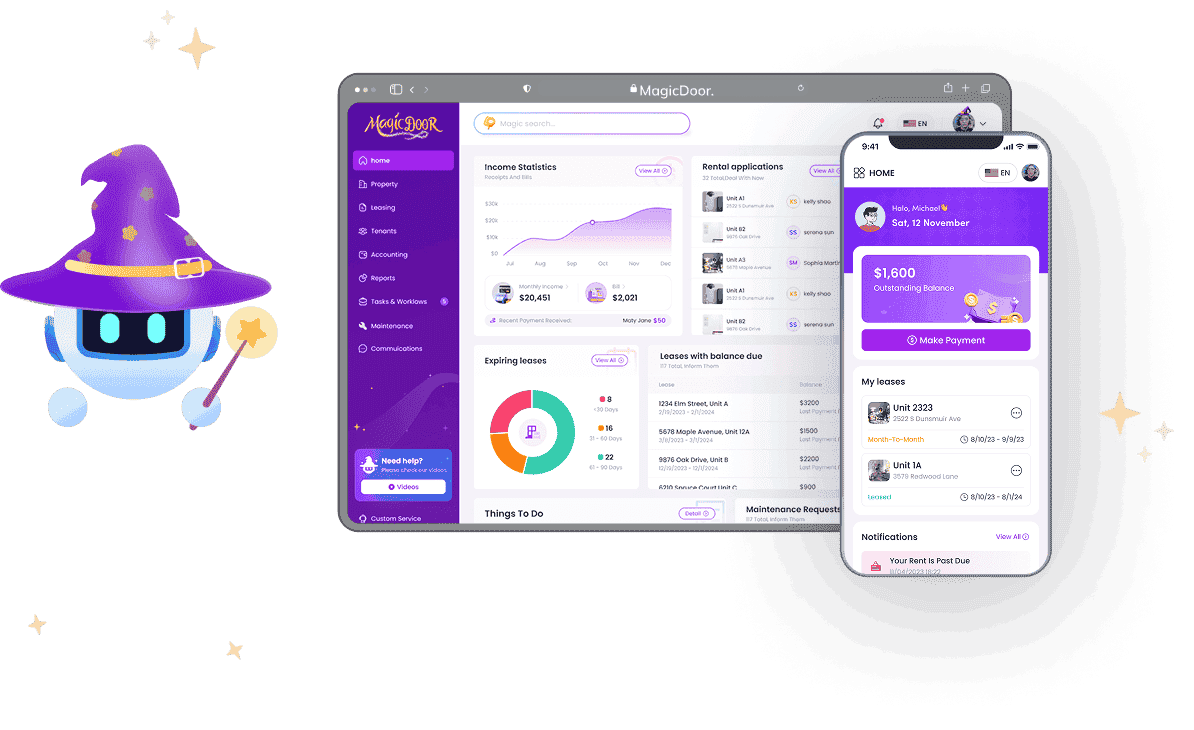
MagicDoor was built from scratch as an AI-native platform, meaning every workflow was designed with AI at its foundation. Founded by a FAANG engineer who managed his own properties and couldn't find software that worked, it launched in 2024 with $2M in pre-seed funding from Shadow Ventures.
The AI works directly inside your daily workflows rather than sitting alongside them as a chat interface.
It scores rental applications on a 1–100 scale, translates tenant and manager messages in real time, triages and prioritizes maintenance requests, auto-drafts lease renewals, and manages communication across text, email, and portal, all without manual handoffs between tools.
MagicDoor features include:
- AI-powered maintenance management: Auto-prioritizes requests, assigns vendors, and coordinates resolution
- Magic Score: AI applicant scoring from 1 to 100 based on credit, income, and rental history
- Automated rent collection with customizable late fees and NSF fees
- Real-time multilingual communication: Auto-translates messages between tenants, managers, and vendors
- Lease generation, digital signing via text or portal, and renewal tracking
- AI-powered property listings with automated syndication
- Full accounting with general ledger and 1099 preparation
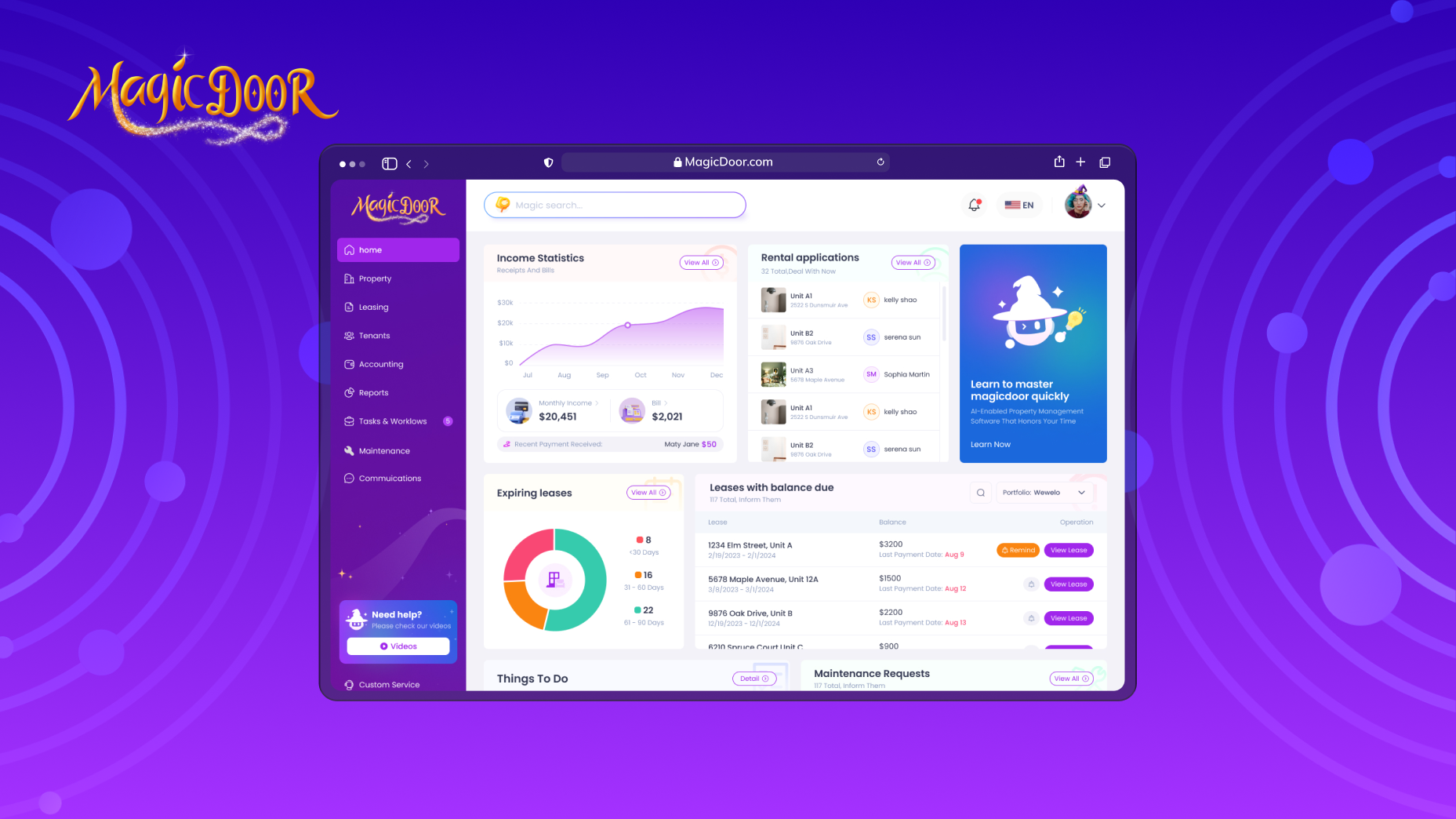
- Customizable dashboards with live payment, lease, and maintenance data
- Tenant and owner portals
- Mobile app for iOS and Android
Pricing:
- Free: $0/mo (up to 10 leases)
- Advanced: $25/mo (unlimited leases)
- Pro: $225/mo (unlimited leases)
- All features include unlimited AI features with Genie AI
Best for: Property managers and landlords on any portfolio size who want a platform where AI handles the functional work, not just assists with it, at pricing that stays predictable whether you manage 5 units or 5000.
AppFolio
AppFolio is one of the most established platforms in the space, built for mid-to-large residential and commercial portfolios. Its financial reporting and accounting tools are among the most comprehensive available, and it covers the full property management lifecycle in one system.
AppFolio features:
- Full accounting: General ledger, accounts payable/receivable, bank reconciliation, CAM tracking
- Online rent collection via ACH and credit card
- Tenant screening with credit and background checks
- Maintenance request tracking with vendor management
- AI-powered leasing assistant for automating routine tasks
- Marketing tools with multi-platform listing syndication
- Owner and resident portals
- Mobile app for iOS and Android
Pricing:
- Pricing varies by property type: residential, commercial, and community associations each have separate rates
- Minimum of 50 units to get started
- No free trial on most plans; pricing is not fully public and requires contact for larger tiers
Best for: Property management companies handling 50+ residential or commercial units who need enterprise-grade accounting, and can absorb the minimum monthly spend.
TurboTenant
TurboTenant is one of the most widely used free platforms for independent landlords, with over 1 million users. The free plan covers the main landlord workflow well enough that many small portfolio owners never need to upgrade.
TurboTenant’s features:
- Property listing syndication across Realtor.com, Facebook Marketplace, Rent.com, Redfin, and others
- Online rent collection with autopay, payment reminders, and automatic late fees
- Tenant screening, credit, background, and eviction checks (paid by applicant)
- State-specific lease agreements with e-signature (unlimited on paid plans)
- Maintenance request tracking
- Rental accounting with bank sync, auto-categorization, and Schedule E reporting
- Tenant and landlord messaging within the platform
- Mobile-friendly browser interface (no dedicated app)
Pricing:
- Free: unlimited properties
- Essential: $12.42/mo billed annually.
- Pro: $16.58/mo billed annually
Best for: Independent landlords managing up to 50 residential units who want a clean, functional starting point at no cost, and don't need deep accounting integrations or commercial property support.
ResMan
ResMan is purpose-built for multifamily and affordable housing, conventional apartments, HUD properties, Tax Credit housing, and Rural Development programs.
It's not a general-purpose landlord tool; it's an enterprise platform for property management companies running large portfolios with serious compliance requirements.
ResMan features:
- Full accounting: general ledger, accounts payable/receivable, budgeting, financial reporting
- AI-powered leasing assistant and marketing CRM
- Resident portal for payments, maintenance requests, and communication
- Customizable BoardRoom dashboard with real-time KPI visibility
- Lease management with Blue Moon integration and DocuSign e-signature
- Maintenance and work order tracking
- Bulk messaging tools for resident communication
- Open API with integrations for screening, payments, and marketing platforms
Pricing:
- Custom quote only, no public pricing
- No free trial
Best for: Multifamily property management companies running large conventional or affordable housing portfolios with compliance requirements. Not suited for small independent landlords or mixed residential/commercial setups outside the multifamily sector.
Conclusion
By the time you finish evaluating property management software, most platforms will have used the word "AI" at least a dozen times. The question worth asking is what that word is doing in each sentence, whether it describes something the software does on its own, or something you still have to prompt, configure, and supervise.
An AI assistant helps you work. An AI-native platform works without you having to ask. That difference doesn't show up in a feature list or a badge. It shows up in how many hours you spend managing the software versus managing your properties.
Before committing to any platform, ask three things:
- What does the AI do without me prompting it
- What happens when something goes wrong and I need a human?
- What will this cost me in 12 months across every fee, subscription, transaction, and add-on?
DoorLoop has real strengths. It also has documented differences in pricing transparency, support access, and the distance between its AI marketing and what the product delivers day to day.
MagicDoor is the only property management platform built as AI-native from the ground up, not a traditional platform with a ChatGPT wrapper. That's a claim we can back up. And when something goes wrong, you reach a person, not a bot, because the problems that matter to your business deserve a real answer.
Related articles





One platform for smart AI-automated rental management