
10 Best Property Management Financial Reporting Software Tools in 2026
Get expert property management insights, straight to your inbox.
Closing the books at month-end shouldn't take three days.
For property managers running owner statements across 80 leases, the time loss usually traces back to the software powering the books.
This guide compares the 10 property management financial reporting software platforms most property managers and landlords rely on in 2026, evaluated through one specific lens: reporting depth as the primary filter, with pricing, portfolio fit, and trust accounting weighed alongside.
Skim the Top Picks block below for the verdict in 30 seconds, read the full reviews further down for depth, or scan the comparison table for the spec sheet.
The Right Financial Reporting Tool for Each Type of Landlord
Before getting into the long-form reviews, here's the short version. If you're skimming this on a Tuesday morning between owner calls, scroll the verdicts below and find your scenario. Each one points to the tool that fits a specific portfolio shape and reporting need, based on what the software does well and where it falls flat.
No tool wins every category. The platform that produces beautiful owner statements for a 300-unit PM company is overkill for a landlord with four duplexes. Match the tool to the work, not the other way around.
- Best overall for property managers handling owner reporting: MagicDoor. Full general ledger and automated owner distributions at a flat rate that doesn't scale with unit count.
- Best for growing portfolios that need trust accounting: AppFolio. Real-time owner statements and 1099 e-filing are built into every tier.
- Best for individual landlords with portfolios under 20 units: Stessa. Free Schedule E reports, automatic transaction categorization, and tax-ready exports.
- Best for multifamily and mixed-portfolio operators: Buildium. Handles residential and small commercial books in one ledger with property-level P&Ls.
- Best free option for self-managing landlords: Innago. Income and expense tracking, bank reconciliation, and downloadable reports at no cost.
- Best for customizable financial reports: Rent Manager. Drag-and-drop report builder with hundreds of pre-built templates and custom field logic.
How We Evaluated Financial Reporting Software for Property Managers
Most "best of" lists rank software by feature count. We didn't.
A platform can list forty reports on a marketing page and still leave you exporting to Excel every Friday because none of them are filterable by owner. Feature counts tell you what a tool claims. They don't tell you what it does on a busy month-end.
Our list is built from desk research: product documentation from each vendor, pricing pages confirmed in late 2025, and recent user reviews on G2, Capterra, and Reddit threads where property managers vent honestly about what their software is doing to their weekends.
We didn't run live trials of every platform. We did read what people who use them have to say.
Six criteria carried the most weight in our ranking.
Reporting depth and customization. Income statements, balance sheets, cash flow statements, owner statements, and rent rolls had to be available out of the box, with filters for property, owner, or portfolio. Extra weight went to platforms that let users build custom report templates without exporting raw data into a spreadsheet.
Trust accounting and compliance. For property management accounting, the platform had to keep client funds separate, track security deposits and operating reserves correctly, and produce records that hold up to a state audit. Trust accounting is non-negotiable for any PM company managing on behalf of owners, and the rules vary significantly by state.
Automation of bookkeeping tasks. Specialized real estate accounting software saves property managers an average of 150 hours a year on bookkeeping when rent collection, late-fee application, bank feeds, and reconciliation run automatically. We gave higher marks to platforms where the accounting system syncs directly with rent collection rather than treating them as separate modules wired together by the user.
Tax preparation and 1099 handling. Year-end shouldn't require a CPA to separate twelve months of mislabeled deposits. Platforms earned credit for built-in 1099 e-filing, Schedule E exports, vendor tax tracking, and audit trails that survive a tax review.
Integration with the rest of the operation. Financial data has to flow from leases, maintenance work orders, and payment processors into the ledger without anyone re-keying it. Centralized systems cut administrative work by 40 to 60 percent compared to disconnected tools, and that gap is most painful at month-end.
Pricing and portfolio fit. A platform priced for 8,000-unit operators isn't right for someone managing 30 units, and the reverse is equally true. We scored each tool on whether the cost structure makes sense at the portfolio size it's built for, including transaction fees and add-on charges that quietly show up at renewal.
Every tool on the list cleared a minimum bar across all six. The ranking reflects how well each one fits a specific kind of property manager, not a single universal scoreboard.
What Property Management Financial Reporting Software Should Do
Forget the marketing pages for a minute.
The honest test for any property management accounting software is what happens on the last Friday of the month, when an owner emails asking why their distribution is short, and the answer is buried somewhere between a bank deposit, a maintenance invoice, and a late fee that may or may not have posted.
The right tool turns that question into a thirty-second answer. The wrong one turns it into a Saturday.
A property management software solution earns its keep by producing detailed financial reports without anyone having to assemble them by hand. That's the line. Everything else is decoration.
Here's what the tool should do for you, broken down by the work it replaces.
- Generate financial reports on demand: Income statements, balance sheets, cash flow statements, owner statements, and rent rolls should be one click away, filterable by property, owner, or portfolio. If you're still exporting raw transaction data into a spreadsheet to build a P&L, the software isn't doing accounting. It's doing storage.
- Run online rent collection through the same ledger that produces your reports: Rent payments, automated rent reminders, late fees, and NSF charges should post to the right account the moment they happen. Bolt-on payment processing that doesn't sync with the books creates the exact reconciliation problem that property management accounting software is supposed to solve.
- Handle trust accounting properly: Security deposits and operating reserves are not your money. They belong to owners and tenants, and most states have rules about how they're held, tracked, and reported. The tool needs to keep those funds separate, tag them correctly, and produce records that survive a state audit without panic.
- Keep income and expense tracking automatic: Bank feed connections, transaction categorization, and reconciliation should run on a schedule. Property managers using specialized accounting software save around 150 hours a year on bookkeeping when this part runs on its own. That's almost a full month of work clawed back from a category nobody enjoys.
- Centralize lease management with the books: Lease tracking, lease agreements, renewal dates, rent escalations, and security deposits should sit in the same system as the ledger. When a lease renews at a higher rent, the next month's owner statement should reflect it without anyone having to touch a calculator.
- Surface arrears and cash flow in real time: Real-time dashboards let property managers spot delinquency and vacancy trends the day they form, not three weeks later when the month closes. Faster visibility means faster intervention, which means more rental income protected.
- Produce tax-ready documentation throughout the year: Schedule E exports, 1099 e-filing, vendor tax tracking, and clean audit trails should be byproducts of normal use. Specialized accounting software keeps property managers compliant with tax calculations and reporting requirements, reducing the risk of penalties appearing the following spring.
- Integrate with the rest of the operation: Maintenance management, tenant portals, lease administration, and payment processors all generate financial events. Those events have to flow into the ledger without anyone re-typing them. Centralized systems eliminate duplicate data entry and significantly reduce human errors associated with manual spreadsheets.
- Protect the data it holds: Financial records include bank accounts, tenants' SSNs, owners' tax IDs, and lease terms. Cloud-based storage with proper encryption, access controls, and backup is no longer optional. It's a baseline expectation tied to legal and tax compliance.
If the property management system you're evaluating doesn't do those ten things cleanly, the rest of the feature list doesn't matter. You'll spend the time you saved on automation chasing the gaps.
Side-by-Side Comparison of the Top 10 Financial Reporting Tools
The full reviews come later in this guide, but most property managers want the snapshot first.
Pricing, supported portfolio size, included AI, transaction fees, and where each tool actually shines tend to be the four or five data points that decide a shortlist.
The table below puts those side by side so you can scan.
| Tool | Best For | Starting Price | Trust Accounting | 1099 E-Filing |
|---|---|---|---|---|
| MagicDoor | Any size PM or landlord | Free (1–9 leases) | Yes | Included |
| AppFolio | Mid-size to large PM companies | $298/mo (50-unit min) | Yes | Included |
| Buildium | Mid-market residential PM and HOA | $58/mo (up to 150 units) | Yes | Included |
| DoorLoop | Growing residential PM with modern UI | $59/mo (up to 20 units) | Yes | Add-on (Pro+) |
| Yardi Breeze | Small-to-mid residential and commercial | $100/mo ($1/unit) | Yes | Included |
| Rent Manager | Operators needing deep customization | $200/mo ($1/unit) | Yes | Included |
| Stessa | Real estate investors, finance-first | Free | No | Not available |
| TurboTenant | DIY landlords under 25 units | Free / $8.25/mo | No | Not available |
| Innago | Self-managing landlords, free platform | Free | No | Not available |
| Rentec Direct | Mid-size PM with trust accounting | $45/mo ($2/unit) | Yes (Rentec PM) | Included |
A few patterns are worth flagging before moving on.
Pricing structure matters more than headline price. A platform listed at $69 a month with per-unit fees climbs faster than a flat-fee plan once a portfolio exceeds 50 leases. Transaction fees on rent payments compound quickly across multiple properties, and most "starting at" prices don't include them.
AI is no longer a premium-tier add-on across the market, but the depth varies significantly.
Some tools market AI as a chatbot that answers FAQs. Others use it to convert tenant texts into work orders, post payments to the correct account, and flag accounting anomalies before they appear in a report. Read the AI column with that distinction in mind.
Most platforms cover residential rentals well.
Fewer handle residential and commercial properties cleanly in the same ledger, and only a small subset supports trust accounting at the level a multi-state PM company needs. If your portfolio mixes property types, narrow your shortlist on that requirement first before optimizing for price.
Top Reporting Tools for Property Managers, Compared
1- MagicDoor
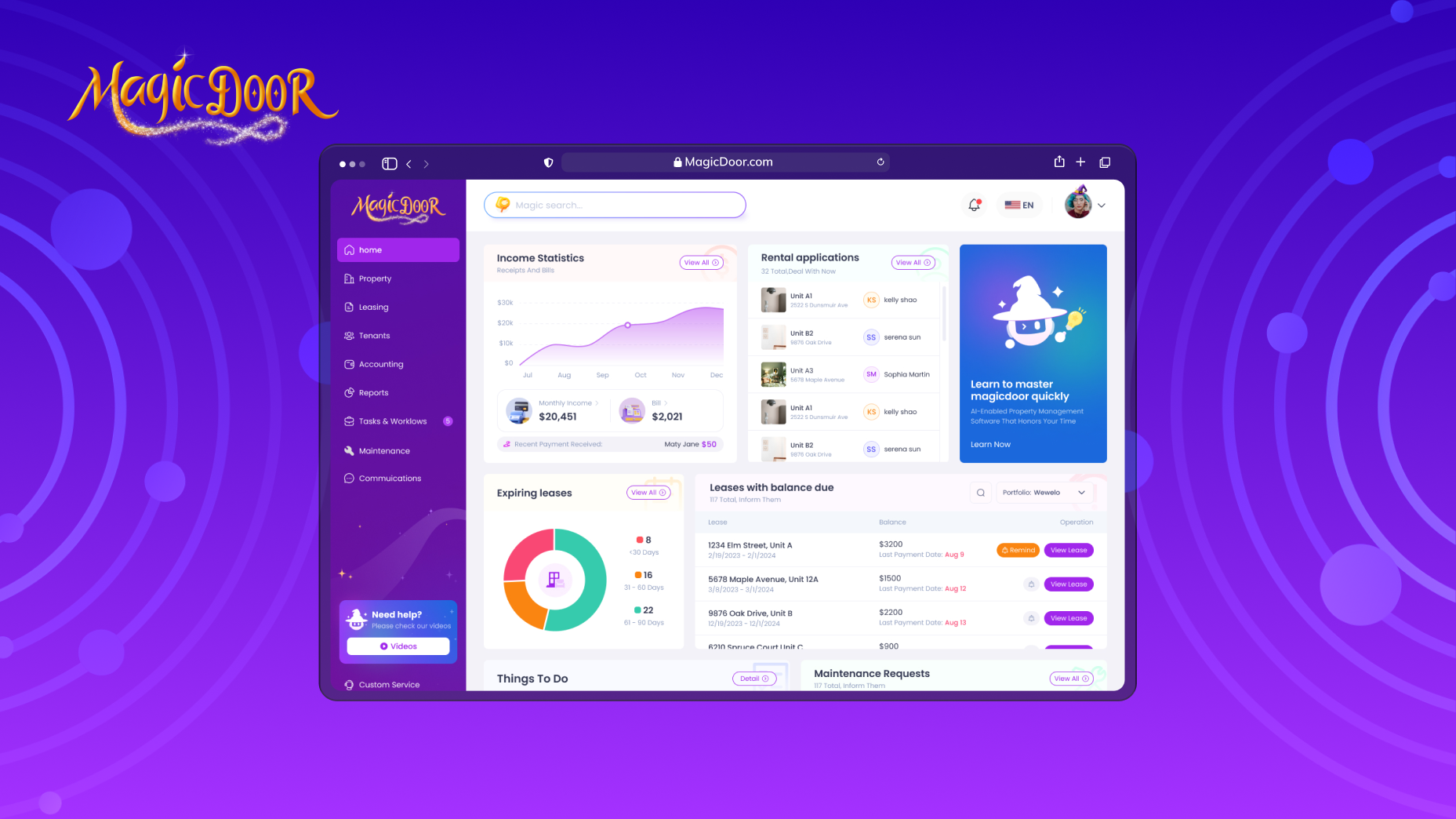
MagicDoor is an AI-native property management automation platform built with Genie AI, an agentic layer that runs the work.
The financial reporting suite handles trust accounting, owner disbursements, and 1099 prep at every tier, and Genie AI is included on all plans. What makes MagicDoor different in this category is the pricing structure: the Pro tier is flat regardless of unit count, with no transaction fees on online rent payments and white-glove data migration included.
Real users running 85, 700, and 8,000+ unit portfolios across multiple states use the same accounting tools, dashboards, and general ledger.
The platform supports residential, multifamily, commercial, mixed-use, student housing, community associations, and affordable housing in a single property management system, with live delinquency tracking and owner portals built into every plan.
Key financial reporting features:
- Real-time owner statements and automated owner disbursements with full audit trails
- Trust accounting that keeps client funds separate and tracks security deposits per state rules
- 1099 prep, Schedule E exports, and tax-ready reports built directly into the property management accounting layer
- Live delinquency dashboards across multiple properties at the portfolio, owner, or unit level
- Genie AI categorizes bank transactions, applies late and NSF fees, and flags accounting anomalies before they reach a financial statement
- Full integration of rent collection, leasing, maintenance for property management, and tenant screening into the same general ledger
Pricing:
- Free for 1–9 leases.
- Advanced at $25/month for 10+ leases.
- Pro at $225/month flat for 50+ leases, with no transaction fees and white-glove migration included.
- Genie AI on every tier.
Best for: Property managers and landlords at any portfolio size who want full Genie AI, predictable cost as the business grows, and trust accounting built into the same platform that handles online payments and maintenance.
Not ideal for: Short-term and vacation rental operators (MagicDoor supports long-term rentals only) and managers who prefer fully manual workflows over AI execution.
A property management platform priced like a small landlord plan and built to run an 8,000-unit operation without changing the bill.
2- AppFolio
AppFolio is one of the most established names in residential property management software, with a double-entry accounting engine, real-time reporting, and a strong owner portal that long-time users praise for accuracy.
The Realm-X AI layer launched at NAA Apartmentalize 2025 added agentic workflows for unit turns, leasing, and maintenance coordination. Pricing is per-unit with a 50-unit floor, which makes the math work cleanly for professional property management companies but pushes smaller operators out of the conversation entirely.
Key financial reporting features:
- Double-entry accounting with trust accounting separated from operating accounts
- Property-level and portfolio-level financial statements (P&L, balance sheet, cash flow)
- Automated late fees, smart bill entry that reads vendor invoices, and bank feed reconciliation
- Owner statements with real-time data refresh and customizable formatting
- Financial Diagnostics page that flags discrepancies (such as security deposits not matching bank balances)
- Integrated [online payment processing] with automatic posting to the correct ledger
Pricing:
- Core: Around $1.40–$1.60 per unit/month ($280–$298 monthly minimum). Suitable for smaller, traditional portfolios.
- Plus: Around $3.00–$3.50 per unit/month ($900–$1,500+ monthly minimum). Includes added automation and workflow tools.
- Max: Around $5.00+ per unit/month ($7,500+ monthly minimum). Designed for large, complex portfolios requiring advanced, customized, and AI-driven.
- Tenant payment fees apply on top.
AppFolio is best for: Professional property management companies running 200+ units that need deep accounting, mixed-portfolio support, and an established AI roadmap.
AppFolio is not ideal for: Operators under 50 units (priced out by the minimum), and teams that depend on responsive customer support, since reviewers consistently flag long ticket response times in 2025 and 2026.
A polished accounting and reporting platform for mid-sized and larger portfolios, with a price tag that scales every month, as a new unit is added.
3- Buildium
Buildium has been one of the most widely adopted property management tools for mid-sized property management companies since its 2004 launch in Boston.
The platform was acquired by RealPage in 2019 and now serves over 17,000 property management companies, with strong showings in residential property management, community associations, and student housing.
Its accounting engine is consistently called out by reviewers as one of the cleanest in the category, with full general ledger support, GAAP-recognized financial reporting, and a depth of trust accounting that earns particular recognition from operators handling HOA reserve funds.
Key financial reporting features:
- General ledger accounting with property, owner, and portfolio-level financial statements
- Standard reports include balance sheets, owner statements, cash flow, income statements, and budget vs. actuals
- 1099 e-filing built in, with vendor tax tracking handled within the same accounting software
- Trust accounting that separates client funds from operating accounts and supports HOA reserve compliance
- Lumina AI assistant for bill scanning, communication drafting, and writing assistance on Premium
- Bank reconciliation with bank feeds and integrated rent collection for automated posting
Pricing:
- Essential at ~$62/month (up to 150 units)
- Growth at ~$192/month
- Premium at ~$400/month
- EFT, eSignature, screening, and bank setup fees apply on top, usually adding 30–50% to the base subscription
Buildium is best for: Residential property management companies and HOA managers running 50–500 units who want clean accounting, predictable tier pricing, and reliable owner reporting without an enterprise learning curve.
Buildium is not ideal for: Self-managing landlords with 20 units or fewer (Essential is too rich for the use case), large commercial-only portfolios, and operators who need deep, customizable reports without paying for the Premium tier or layered Open API access.
A solid mid-market property management platform with strong residential accounting depth, weighed down by transaction fees that quietly inflate the real cost of ownership.
Operators on the fence often run a side-by-side vs Buildium comparison before committing.
4- DoorLoop
DoorLoop is a Miami-based platform launched in 2021 and aimed at residential property managers who want a cleaner interface than the older incumbents.
The financial reporting suite covers automated rent collection, bank reconciliation, real-time dashboards, and 1099 prep, with a QuickBooks Online sync available on the Pro tier and above.
DoorLoop's Operational Intelligence AI handles lease renewals, rent reminders, and maintenance routing, putting it in the same category as other newer property management software designed around automation rather than just task organization.
Key financial reporting features:
- Real-time financial reporting with customizable dashboards across multiple properties
- Property-level and company-level books, with full income and expense tracking
- Bank reconciliation and live bank connect on Pro and Premium tiers
- QuickBooks Online sync is available on Pro and Premium for deeper accounting integration
- Owner portals, owner statements, and 1099 e-filing are handled within the same property management system
- Automated late fee rules, recurring rent payment scheduling, and customizable A/R aging summaries
Pricing
- Starter at $69/month (up to 20 units, billed annually)
- Pro at $139/month
- Premium at $199/month
- ACH fees and credit card fees are charged to tenants on Starter and Pro; ACH is free on Premium.
DoorLoop is best for: Growing residential and mixed-use property management companies between 20 and 500 units that want a modern interface, full general ledger accounting, and an open API on the top tier.
DoorLoop is not ideal for: Operators under 10 units (Starter is over-built for the use case) and PM companies needing deep custom report flexibility, since reviewers consistently flag report customization as one of DoorLoop's thinner areas.
A polished newer entrant with a strong daily-use experience, best matched to operators willing to upgrade tiers for the financial features that matter most. Many PMs evaluate it through a structured vs DoorLoop review against the platform they're switching from.
5- Yardi Breeze
Yardi Breeze is the simplified, cloud-based property management software built by Yardi (the company behind enterprise platform Voyager) for small-to-mid portfolios that don't need the complexity of an enterprise system.
Two versions exist: Breeze for residential and commercial use, and Breeze Premier for more specialized property types such as affordable housing, HOAs, manufactured housing, and self-storage.
The pricing structure is simple, the implementation is free, and Yardi eliminated ACH payment fees in January 2024, which sets it apart from most platforms that still pass those fees through to tenants.
Key financial reporting features:
- General ledger with accounts payable, accounts receivable, and drill-down financial statements
- Customizable financial statements and owner reports on Breeze Premier
- Automated CAM reconciliation built in for commercial property management software users
- Standard reports include rent rolls, vacancy reports, balance sheets, and tenant ledgers
- Built-in tenant screening, online rental applications, and integrated lease management
- AI-powered chatbot for resident self-service and after-hours communication
Pricing:
- Breeze: $1/unit/month residential ($100 minimum), $2/unit/month commercial ($200 minimum)
- Breeze Premier: $2/unit/month residential, $4/unit/month commercial ($400 minimum)
- Premier is $1/unit if bundled with resident screening/renters insurance and a 12-month contract
- Free implementation and training included
Yardi Breeze is best for: Small-to-mid portfolios under 300 residential or 100 commercial units that want clean accounting tools, native CAM handling, and the simplicity of a Yardi product without Voyager's enterprise pricing.
Yardi Breeze is not ideal for: Property managers needing deep custom reporting (Breeze's standard reports are clean but limited), portfolios with more than 1,000 units that will quickly outgrow the platform, and teams expecting fast same-day phone support beyond the included setup hours.
A clean, predictably priced cloud-based solution with strong commercial accounting credentials, best matched to portfolios that prefer simplicity over deep customization. Many teams comparing options run a structured vs Yardi Breeze review before committing.
6- Rent Manager
Rent Manager has been around since 1985 and remains one of the most customizable property management platforms on the market.
The reporting library alone covers more than 450 built-in reports, ranging from accounting staples such as balance sheets and P&L statements to property-specific reports like rent rolls, vacancy reports, and waitlist tracking. The accounting engine runs cash and accrual simultaneously, and AI-assisted accounts receivable and payable workflows handle bank reconciliation, invoice processing, and check scanning.
An overview of a rent manager without mentioning the depth of customization would miss the entire reason teams choose it.
Key financial reporting features:
- 450+ built-in reports covering residential, multifamily, commercial, mixed-use, and specialized portfolios
- Double-entry accounting with simultaneous cash and accrual support, plus full general ledger control
- AI-assisted accounts payable software workflows, bank reconciliation, and check scanning
- Customizable workflows that let teams build report templates without exporting raw data
- Cash flow tracking, P&L by property, balance sheets, and detailed financial reporting at the portfolio level
- Mobile inspections, work order management, and metered utility tracking are integrated with the financial layer
Pricing:
- Basic at $1/unit/month ($200 minimum)
- Plus at $1.50/unit/month ($300 minimum)
- Premium at $2.25/unit/month ($450 minimum). Implementation fee equals 2x the monthly subscription
- Add-ons (call center, website dev, integrations) carry separate costs
Rent Manager is best for: Mid-size to large multifamily users with 200+ units who need deep accounting customization, complex reporting, and the flexibility to handle every property type in one ledger.
Rent Manager is not ideal for: Small landlords under 50 units (the minimums and learning curve don't match the use case) and teams that want a clean, modern interface out of the box, since reviewers consistently flag the older UI and steep onboarding period.
The most customizable property management platform in this category, with reporting depth that rewards teams willing to invest the setup time. Many teams shortlist it through a side-by-side vs Rent Manager review before signing.
7- Stessa
Stessa is a free platform built for individual landlords and real estate investors who care more about portfolio performance than full property management operations.
Owned by Roofstock and used by more than 250,000 landlords, the software focuses on automated income and expenses tracking, single-entry accounting, and tax-ready reports built around how investors actually file.
Free Schedule E exports, Tenant Ledger reports, and Net Cash Flow dashboards arrive alongside automated bank feeds and basic rent collection.
Key financial reporting features:
- Real-time dashboards with Income Statement, Net Cash Flow, Schedule of Real Estate Owned, and Tenant Ledger reports
- Single-entry accounting with automated bank feed categorization across all connected bank accounts
- Free Schedule E exports and Tax Package reports built around how to prepare for tax season as a landlord
- High-yield landlord banking through Thread Bank, with separate accounts for each property
- Receipt scanning via mobile, recurring transaction categorization, and DocuSign-powered eSignatures
- Automated rent collection with payment reminders, late fees, and ACH or credit card processing
Pricing
- Essentials at $0 (free, unlimited properties)
- Manage at around $12/month (annual)
- Pro at $28/month annual ($35 monthly), with higher banking APY and advanced reporting
- The free tier was downgraded in 2024
Stessa is best for: Real estate investors and landlords focused on portfolio performance, tax preparation, and a single-family portfolio who want strong financial tracking without paying for property management software they won't fully use.
Stessa is not ideal for: Property management companies managing on behalf of clients (single-entry accounting and the absence of trust accounting make Stessa a poor fit), and landlords who need owner statements, full work order management, or rent collection without using Stessa's banking layer.
A finance-first platform that earns its place with investors who want clean books and tax-ready reports, not full property management.
8- TurboTenant
TurboTenant is a free property management platform built for self-managing landlords with smaller residential portfolios.
Founded in 2015 in Fort Collins, the company now serves more than 900,000 landlords across all 50 states. The free tier covers listing syndication, tenant screening, lease creation, rent collection, and maintenance tracking, which is more than most paid platforms include at their entry tier.
Accounting is powered by REI Hub (which TurboTenant acquired) and offered as a separate paid add-on rather than rolled into the Premium subscription.
Key financial reporting features
- 40+ rental-specific reports, including P&L, Balance Sheet, Cash Flow, NOI, and Schedule E exports
- Property-level double-entry accounting with an expandable Chart of Accounts and manual journal entries
- Automated bank feeds via Plaid and Yodlee, with rule-based transaction categorization
- Income and expense tracking with receipt upload and per-property tagging
- Listing syndication to Zillow, Apartments.com, Realtor.com, and over 20 other sites helps support how to list a rental property cleanly
- Premium adds unlimited electronic lease signing, state-specific lease templates, and faster rent processing
Pricing:
- Free for landlords (tenants pay $55 per application)
- Premium starts at $8.25/month billed annually
- Accounting add-on (REI Hub) costs $15/month for the first unit, plus $5/month per additional unit, capped at $85/month.
TurboTenant is best for: DIY landlords with 1 to 25 residential units who want a usable free plan for marketing, screening, and rent collection, with an option to add real accounting later.
TurboTenant is not ideal for: Property management companies serving outside owners, commercial portfolios (the accounting layer is residential-focused), and growing portfolios above 30 units that will need trust accounting and owner reporting that the platform doesn't offer.
A genuinely free landlord platform with one of the strongest free tiers in the category, paired with optional accounting power that scales when the portfolio is ready for it.
9- Innago
Innago is one of the few genuinely free property management accounting software platforms on this list, with no monthly subscription, setup fee, or contract.
It tends to attract landlords reading signs it's time to stop managing rental properties on spreadsheets for the first time, since the platform handles rent collection, lease signing, and maintenance requests without ever asking for a credit card.
The company makes its money from tenant-side fees (screening reports, optional renters insurance, card processing) rather than from landlord subscriptions. Reviewers consistently call out customer support as the platform's standout strength.
Key financial reporting features:
- Income and expense tracking with payment history records, dashboards, and reconcilable transaction logs
- Automated invoicing, recurring rent charges, late fee rules, and digital receipts
- Free ACH rent collection with tenant-paid card processing as an alternative
- Lease management with digital lease signing and customizable lease templates
- Built-in work order software for maintenance requests, vendor coordination, and tenant communication
- One-way QuickBooks sync for landlords who want deeper accounting outside the platform
Pricing:
- Free for landlords. No monthly or annual fees
- Tenant screening reports cost roughly $30–$40 per applicant (paid by tenant)
- Optional credit card processing fees are passed through to tenants
Innago is best for: Self-managing landlords with 1 to 50 residential units who want a usable free plan covering rent collection, lease signing, and maintenance, plus a customer support team that picks up the phone.
Innago is not ideal for: Property management companies that need trust accounting (Innago doesn't offer it), portfolios above 100 units that need deep custom reporting, and teams that need a polished mobile app, since reviewers consistently flag the mobile experience as weaker than the desktop version.
A free landlord platform that punches well above its price tag, best matched to portfolios where simplicity and cost matter more than reporting depth.
10- Rentec Direct
Rentec Direct has been quietly serving landlords and property management companies since 2007. The company is privately owned, debt-free, and offers two products: Rentec Pro for landlords and Rentec PM for property managers handling client funds, which is the version recognized as trust-account compliant by third-party reviewers.
Free ACH rent payments, wholesale tenant screening rates, unlimited US-based support, and a free custom website are included at every tier, with no setup fees or term commitments.
Key financial reporting features
- Full general ledger accounting with bank, property, and tenant-level records
- Trust accounting and owner accounting on Rentec PM, with automated owner disbursements
- Built-in [owner portal software] giving owners live access to property performance and statements
- Standard reports include income/expense reports, ledgers, rent rolls, and 1099 e-filing
- Free websites for property management with listing syndication to 20+ rental sites
- Optional QuickBooks synchronization for teams that prefer external accounting depth
Pricing:
- Rentec Pro at $45/month billed annually
- Free ACH for tenants
Rentec Direct is best for Property management companies with 25 to 1,000 units that need trust accounting, free tenant ACH, and a clear pricing structure without setup fees or per-feature add-on charges.
Rentec Direct is not ideal for: Teams that need deep, customizable financial reports (reviewers consistently call the reporting layer thin compared to AppFolio or Rent Manager), portfolios above 5,000 units, and managers who require a polished mobile app for daily field work.
A reliable, predictably priced platform for mid-size PM companies that value trust accounting compliance, free tenant payments, and US-based support over the most modern interface in the category.
How to Choose the Right Financial Reporting Software for Your Portfolio
Most software regret comes from picking a tool that fits the portfolio you had two years ago, or the one you wish you had. Match the platform to where the business is today, with a small allowance for where it'll be in 18 months.
Five questions sit at the center of the decision:
- How many leases are under management today, and where will that number be next year?
- What property types are in the portfolio (residential, commercial, mixed-use, multifamily)?
- Are you reporting to outside owners, or only to yourself?
- How much of the operational work do you want the [property management automation] layer to run without you?
- What's the real monthly cost ceiling, including transaction fees and add-ons?
Once those answers are clear, the shortlist narrows quickly.
A self-managing landlord with three single-family homes and a full-time job needs accurate financial records, Schedule E exports at year-end, and a free rental management software option that handles online payments without nickel-and-diming the resident. Robust accounting features and trust accounting are extra weight, not benefits, for a portfolio this size.
An independent landlord with 25 units sits in a different position.
Online rent collection, automatic late fees, lease management software, and tenant communication tools become daily infrastructure, and the cost of unpaid rent over a single month outpaces a year of software fees. The right property management software at this stage handles routine tasks in the background and surfaces only what requires a decision.
A growing property management business between 50 and 700 units is buying something different again.
Trust accounting for property management, owner reporting, and 1099 prep are non-negotiable, since real estate professionals at this scale answer to property owners expecting institutional-grade financials.
Per-unit pricing structures bite hard around the 100-unit mark, which is why flat-rate platforms quietly become the smart pick well before a portfolio gets large.
Operators with 700+ units across multiple states need portfolio-level visibility, predictable costs across thousands of leases, and a system that doesn't break under volume. Audit trails, role-based access, and tax-ready documentation move from useful to legally required at this scale.
Real estate investors focused on portfolio returns sit slightly to the side of this map.
Their priority is financial tracking and tax preparation, with [tenant management] features layered on lightly. Multi-entity reporting matters more here than daily operations, since investor structures often span LLCs that each need their own clean books.
One filter applies regardless of size: how much of the work should the software run on its own?
Some property management tools organize tasks for the user. Others execute them. The price difference between the two categories looks similar on a comparison page. The hour difference at month-end does not.
Common Mistakes Property Managers Make When Choosing Financial Reporting Software
Most bad decisions about property management software don't come from a lack of research. They come from researching the wrong things.
Demos go well. Sales reps are friendly. The pricing page looks fair.
Six months in, the same managers are rebuilding reports in Excel because something fundamental got missed during the buying process.
The patterns below show up across nearly every switcher story we've read.
Buying for today's portfolio is the first one.
A landlord with 18 units signs up for a free tool, crosses 35 units a year later, and finds the trust accounting features missing entirely. Migrating ledger data mid-year is painful, and rebuilding owner balances from a previous platform is worse.
Choose software with headroom for the next 18 months of growth, since switching costs more than upgrading.
Trusting "starting at" pricing as the real cost is the second.
Headline rates rarely include transaction fees on online payments, eSignature charges, tenant screening fees, ACH processing, or per-property add-ons. A platform listed at $58 a month can quietly bill $300 once payment processing kicks in across multiple properties. Ask for a sample bill at your actual portfolio size before signing anything.
Skipping trust accounting depth during the demo lands third on the list.
Sales presentations focus on dashboards and rent payment screens. Trust accounting gets a 90-second mention buried in a longer feature tour. Six months later, a state audit requests client fund reports, and the platform produces something that doesn't quite match the auditor's expected format.
Trust accounting requires that funds be kept separate and accurately tracked to comply with legal requirements and maintain transparency with property owners. Demo it with real questions.
Confusing report volume with report quality is fourth.
Forty pre-built templates sound impressive until none of them filter by individual owner. Accurate financial tracking depends on whether the specific report you need exists in a format your owners and accountants accept, which has nothing to do with how many reports the marketing page claims. Ask to see an owner statement live during the demo.
Underweighting customer support is fifth, and it's the one most landlords regret.
Property managers running at scale call support during a Friday afternoon emergency, with rent posting wrong on 40 leases. Ticket-only support and multi-day response times turn into lost weekends.
For a property management business with 50 or more units, unlimited priority support is part of the product.
Forgetting that tenant experience is your operation comes sixth.
Rent collection software with a clunky tenant-facing portal increases late payments. Tenant communication that requires an app download fails in multilingual buildings. The right accounting software touches your residents every month, often more than it touches you.
Run the tenant flow during the demo as well.
Ignoring data migration friction is the seventh. Switching from Buildium, AppFolio, or DoorLoop sounds straightforward on a sales call, but how to transition to property management software cleanly is its own project. Real migrations involve historical owner balances, security deposit records, lease terms, and vendor data.
Some platforms include white-glove migration. Others hand over a CSV template and well wishes. Ask exactly who will do the work and how long it will take before signing.
Overlooking security and compliance closes the list.
Cloud-based storage with encryption, role-based access, and SOC 2 compliance protects sensitive financial data and keeps property managers on the right side of legal and tax regulations. Smaller free tools often skip these layers. Saving $30 a month on security becomes expensive the first time something goes wrong.
The thread running through all eight is the same.
Property managers evaluate AI bookkeeping software the way they shop for a phone, leading to feature-by-feature comparisons that miss the moments when software fails. Books that run a portfolio deserve a closer look at three specific moments: month-end close, year-end tax prep, and a state audit.
If the platform handles those cleanly, the rest is detail. If it doesn't, you'll be shopping again in 14 months.
Conclusion
The right financial reporting software depends on three things: portfolio size, reporting depth needed, and whether trust accounting sits within scope.
Each of the 10 platforms reviewed serves a clear segment of the market, and the differences between them tend to come down to fit more than total feature count.
Landlords with portfolios under 20 units who want clean tax-ready reports without paid features often look toward Stessa or Innago. Growing property managers handling owner reporting and trust accounting tend to land on AppFolio or Buildium.
Property managers needing 450+ pre-built reports and deep customization usually shortlist Rent Manager.
For property managers and landlords at any portfolio size who want trust accounting, automated owner disbursements, and Genie AI included on every plan, MagicDoor delivers a property management financial reporting software stack that scales without the bill scaling with it.
Book a MagicDoor demo to see the reporting suite in action.

Frequently Asked Questions
Related articles





Related articles
One platform for smart AI-automated rental management