Best Multilingual Tenant Communication Software for Property Managers in 2026
Get expert property management insights, straight to your inbox.
A Spanish-speaking tenant misses a rent reminder because the email is in English, which they cannot fully read. A Vietnamese maintenance request waits in a coordinator's inbox until someone bilingual returns on Monday. A lease violation notice gets disputed in court because the resident says they did not understand the terms.
Each scene costs money, time, and tenancy.
The cause is the same in every case: communication that breaks at the language line. The best multilingual tenant communication software closes it without forcing property managers to hire bilingual staff for every language in the building. Misunderstandings and compliance risk both drop.
The seven platforms below are built for U.S. residential property managers running portfolios with linguistically diverse tenants. Vacation rental hosts and commercial-only managers won't find their fit here.
TL;DR: The 7 platforms reviewed:
- MagicDoor: AI translation built into the property management platform; all major languages
- TenantText: Standalone AI texting; 60+ languages auto-detected
- Buildium: Outbound AI message translation; English, Spanish, and French only
- AppFolio: Realm-X agentic AI for multilingual maintenance at enterprise scale
- DoorLoop: English and Spanish interface with optional AI Assistant
- TenantCloud: Low-cost basics; no native multilingual
- Visitt: Live Translate inside work orders for multifamily and CRE teams
What is Multilingual Tenant Communication Software?
Multilingual tenant communication software translates messages, notices, lease documents, and maintenance requests between a tenant's preferred language and the property manager's primary language in real time.
The software removes the need for bilingual staff to act as full-time interpreters and gives every resident the same access to information, regardless of which language they speak at home. As communication tools for property management mature, multilingual capabilities have moved from a premium add-on to a baseline expectation.
The category exists because property management operations have outgrown manual translation.
A 200-unit portfolio in Miami, Houston, or Los Angeles will routinely include tenants speaking Spanish, Vietnamese, Haitian Creole, Mandarin, and Portuguese. Google Translate and other basic translation tools can handle a casual exchange, but they break down when a maintenance request involves plumbing terms, when a lease renewal carries legal weight, or when a fair housing notice needs to be delivered in writing.
Multilingual support software now handles three things older translation tools never managed:
- Real-time translation in every channel. SMS, email, in-app messages, and tenant portal entries get translated instantly in both directions, so a Spanish-speaking tenant types in Spanish and the property manager reads English without anyone pasting text into a separate translator.
- AI-powered translation for documents and notices. Lease agreements, late notices, maintenance updates, and knowledge base articles can be generated in the tenant's native language, keeping the property compliant with fair housing regulations and reducing the risk of discrimination claims.
- Centralized multilingual capabilities for the team. Every conversation lives in one thread, with the original and translated versions stored together. New staff can pick up a ticket without re-translating prior history.
The effect is fewer misunderstandings on rent payment dates, fewer misrouted maintenance requests, and a cleaner paper trail when a dispute reaches an attorney. For property management companies handling 50 units or 5,000 units, multilingual communication has moved from a nice-to-have to a baseline once the tenant base includes three or four languages regularly.
Multilingual communication is also a quiet lever for retention.
Tenants who can talk to their property manager in their native language renew at higher rates, file fewer complaints, and refer neighbors. The pattern shows up in renewal data, which is why the software exists at all.
How to Evaluate a Multilingual Platform Before You Buy
Most multilingual platforms look fine in a demo. The problems show up at month three.
A Vietnamese-speaking tenant submits a maintenance request, and the translation engine returns a result that does not match what they requested. Run a structured evaluation before signing.
The four checks below separate translation services that hold up from platforms that look polished only in the sales deck.
Tenant Demographics & Language Distribution in Your Portfolio
Before evaluating any tenant management software with translation features, audit which different languages actually appear in your portfolio. Pull the last 12 months of communication logs, lease applications, and emergency contact records.
Count how frequently each language appears. If 18% of your tenants speak Spanish at home and 4% speak Haitian Creole, those are the two languages your evaluation has to cover well. Vendor demos love to show 100+ language support, but translation quality is uneven. Spanish, Mandarin, and French translations are usually solid.
Smaller languages can produce stilted output that tenants notice immediately, leaving real language barriers in place even with the software installed.
The same audit tells you where multilingual support matters most.
A property in Doral, Florida will need different language coverage than a property in Queens or East LA. Recognizing diversity in tenant demographics is part of underwriting the purchase. Pay for what your portfolio needs, not what the vendor wants to sell you.
Compliance Requirements for Translated Lease Notices
Several states already require translated lease documents in specific scenarios.
California Civil Code §1632 requires landlords who negotiated a lease primarily in Spanish, Chinese, Tagalog, Vietnamese, or Korean to provide a translated copy of the lease. New York City requires translated notices in the top covered languages for certain rent-stabilized buildings. HUD-funded properties have their own obligations under Title VI of the Civil Rights Act for Limited English Proficiency.
Clear communication in the tenant's primary language directly affects legal compliance.
Property managers who deliver eviction notices only in English to a tenant whose lease was negotiated in another language are stacking the legal record against themselves. The same applies to rent increase letters and lease renewals.
Effective multilingual tenant communication software reduces misunderstandings, keeps notices defensible in court, and lowers the risk of fair housing discrimination claims. Confirm the platform can produce legally-acceptable translated lease notices, not casual chat output. Strong tenant relationships start with notices the resident can actually read.
Integration with Existing Property Management Workflows
Translation quality does not matter if the platform sits outside your operational stack. Evaluate these key features and integration points:
- Native integration with your property management software. Translation should run inside the tenant portal, SMS, and email, not in a separate app that the team has to remember to open.
- A user-friendly interface for the team. Bilingual staff should not be required to operate it, and non-bilingual staff should be able to handle a multilingual ticket without training.
- Maintenance ticket flow. Maintenance requests need real-time translation when they enter the system, then translation back when the vendor responds in English.
- Leasing communication. Application questions, showing requests, and lease-signing communication all translate without staff copy-pasting.
- Accounting notices. Late payment reminders, NSF notices, and rent receipts need localized messaging in the tenant's native language.
- Automation features and initial setup. Platforms that take six weeks to configure burn the budget you saved by switching. Look for vendors with under two-week setup timelines.
Test the actual integration in a sandbox before signing. A platform that requires staff to manually trigger translation defeats the purpose. Manual workload should drop after implementation, not stay flat.
Pricing Models & Per-Unit Cost at Scale
Multilingual translation software comes in five common pricing models, and each behaves differently as the portfolio grows.
| Pricing model | How it scales | Watch out for |
|---|---|---|
| Per message translated | Cost rises with tenant volume | High-touch portfolios get expensive fast |
| Per language enabled | Predictable monthly cost | Adding one language can double the bill |
| Per tenant or per user | Linear cost growth | Inactive tenants still count |
| Per unit (flat) | Predictable at scale | May cap usage or document translation |
| Bundled with PM software | No separate translation invoice | Verify which languages and channels are included |
Property managers running mid-sized portfolios should calculate per-unit cost on real usage, not the marketing rate card. Ask the vendor how pricing changes when a single tenant sends 40 messages in a month vs. 4.
Ask whether translated lease documents count against a quota. Ask what happens when you add a new language mid-contract.
Bundled translation built into property management automation usually beats add-on tools once the math is run honestly. Per-unit pricing tends to be the safer bet for growing operators because it keeps the bill predictable as the portfolio expands into multiple languages.
Treat any vendor that cannot quote a clear per-unit number as a red flag. Most bury translation costs inside usage tiers, and the real number only surfaces at renewal. By then, any competitive advantage has quietly disappeared.
The 7 Top Multilingual Tenant Communication Platforms Reviewed
The platforms below are reviewed against four criteria: multilingual coverage depth, integration with property management workflows, pricing transparency, and operational fit for portfolios that need real-time translation.
Each tool solves a different slice of the multilingual support problem.
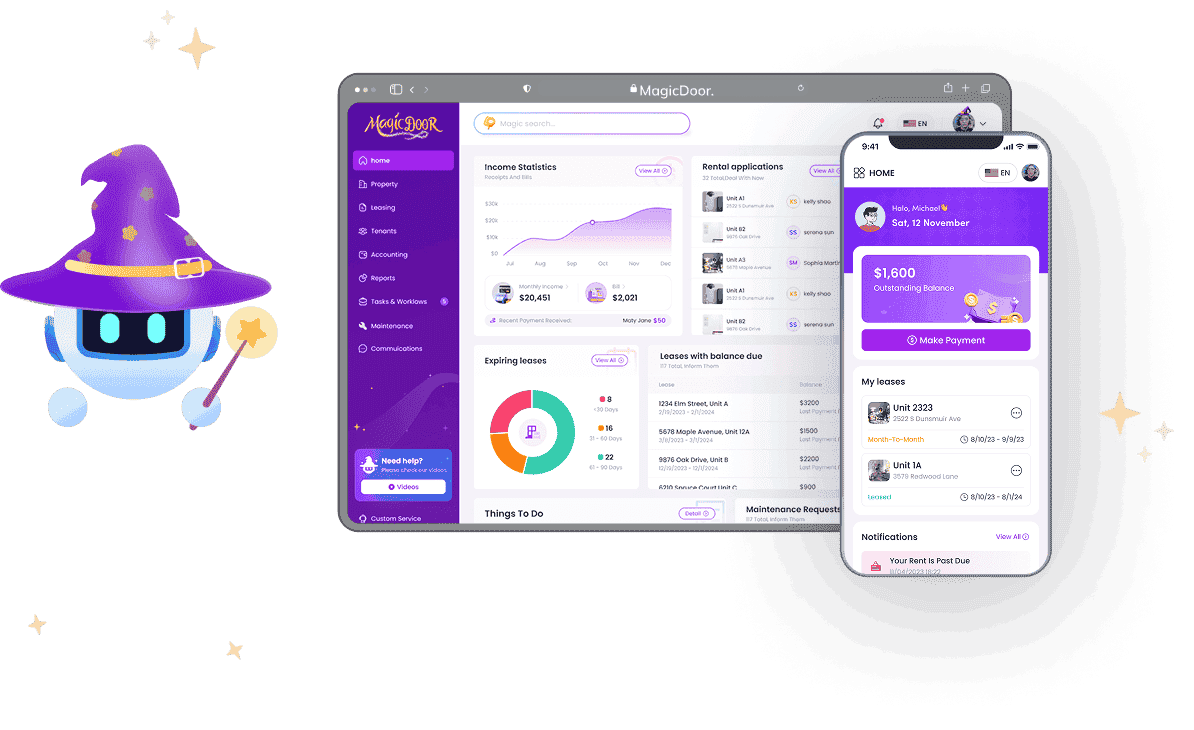
MagicDoor leads the list because it natively builds multilingual capability into the property management software, not as a bolt-on translation layer.
| Platform | Languages Supported | Translation Type | Where Translation Works | Best For | Starting Price |
|---|---|---|---|---|---|
| MagicDoor | AI auto-detect, all major languages | AI real-time, bidirectional | SMS, tenant portal, maintenance requests, lease notices, all communication channels | From small landlords to growing PM companies and portfolio operators running diverse, multilingual portfolios who want translation built into the property management software. | Free (1–9 leases) |
| TenantText | 60+ via AI auto-detect | AI real-time, bidirectional | SMS messaging, maintenance triage, after-hours coverage | Multifamily teams running an existing PMS who need a focused multilingual texting layer | $59/month per property |
| Buildium | 3 (English, Spanish, French) | AI-assisted manual draft translation | Outbound emails, SMS, announcements, templates (not inbound) | Mid-sized PM companies serving primarily English, Spanish, and French-speaking tenants | $62/month (no translation); $192/month with Write with AI |
| AppFolio | Multiple via Realm-X (count not publicly specified) | AI agentic auto-translation | Maintenance requests, resident messaging via Realm-X | Mid-to-large PM teams (200+ units) and enterprise multifamily portfolios | $1.40–$1.49 per unit/month, $280+ monthly minimum |
| DoorLoop | 2 (English, Spanish) | Interface localization plus AI Assistant add-on | Tenant portal interface, AI Assistant Q&A (Tenant Concierge) | Independent landlords and small-to-mid PM companies with primarily English/Spanish tenants | $59/month annual (up to 20 units) |
| TenantCloud | 1 (English primary; limited international interface support) | None built-in (relies on third-party tools) | N/A natively; Google Translate or external tools required | Solo landlords and DIY managers (1–20 units) with primarily English-speaking tenants | $15/month (Starter, annual billing) |
| Visitt | 8 interface languages plus more via Live Translate (Spanish, Portuguese, Mandarin, Hebrew, Arabic, Dutch, French, German, Russian) | AI type-and-go auto-translation (Live Translate) | Work orders, team messaging, tenant chat threads | Mid-to-enterprise multifamily and CRE teams (50+ properties or 1,000+ units) | Custom pricing (quote-based) |
1- MagicDoor: AI-Powered Automated Translation for Tenant Communication
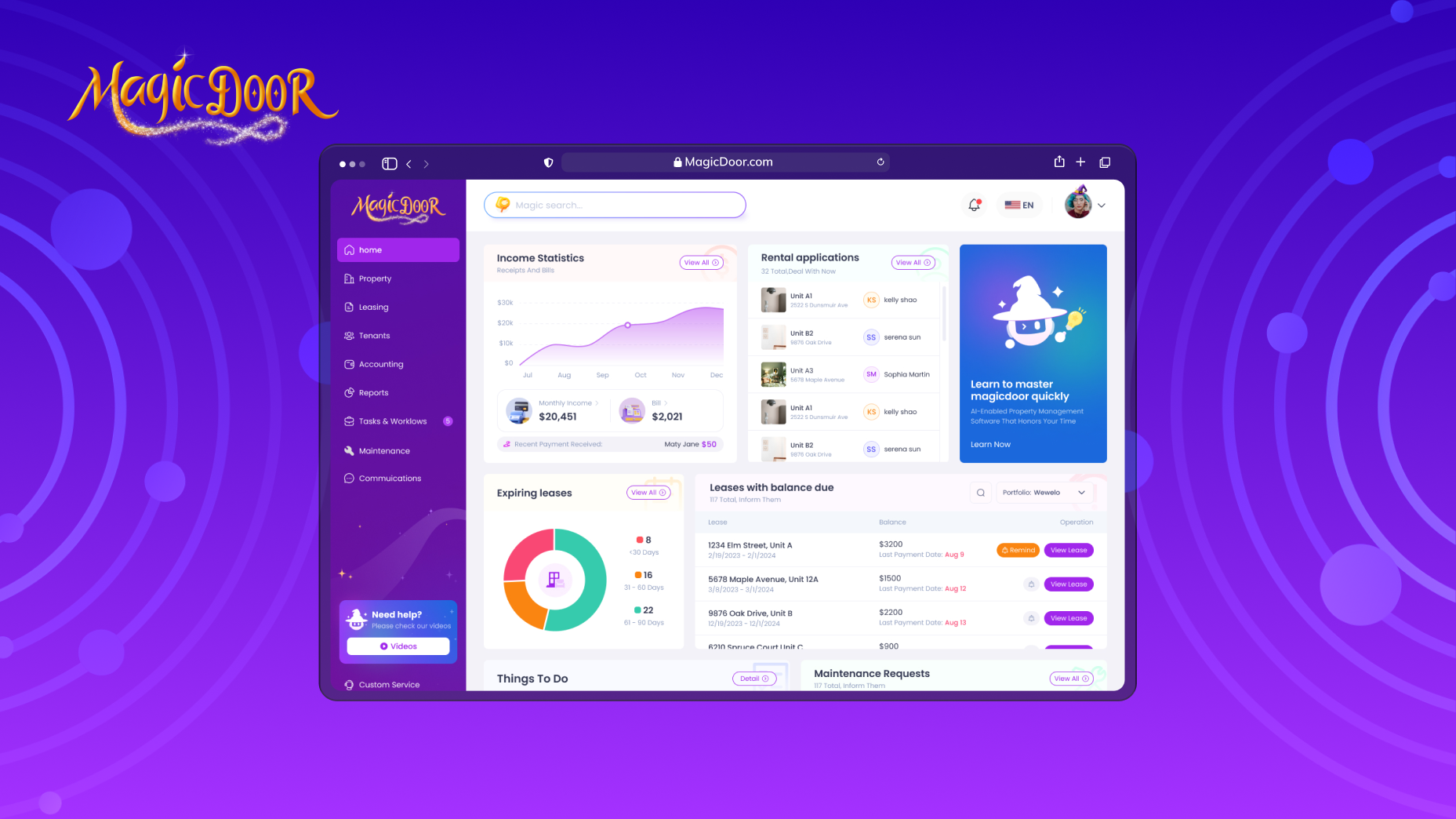
MagicDoor is an AI-native property management platform built for growing PM companies and portfolio operators running 50+ leases. Multilingual features are included on every tier through Genie AI, which handles real-time translation across SMS, the tenant portal, and maintenance workflows.
Tenants do not need to download an app or learn a new portal. They text the building number in their native language, and the message arrives in the staff inbox in clear English.
Tenant communication features:
- Real-time SMS translation in both directions, with no app or portal required for the resident
- Genie AI converts incoming texts in any supported language into structured maintenance work orders
- Localized lease documents, late notices, rent reminders, and renewal letters in each tenant's preferred language
- Conversation history stays threaded with original and translated versions side-by-side for compliance and audit
- Multilingual coverage runs through every staff communication channel: SMS, email, portal, and notice templates, supporting effective communication regardless of which language the tenant uses
Best for: From small landlords to growing PM companies and portfolio operators running diverse, multilingual portfolios who want translation built into the property management software.
Pricing:
- Free for 1–9 leases
- $25/month (Advanced) for 10+ leases
- $225/month flat (Pro) for 50+ leases
- Genie AI is included on every tier. No transaction fees on Pro.
Limitations: Long-term rentals only. Short-term and vacation rental operators should look elsewhere.
For diverse portfolios where tenant communication has to flow in multiple languages without a separate translation tool, MagicDoor builds clear communication directly into the tenant management workflows that drive tenant satisfaction.
2- TenantText: AI-Powered Texting That Auto-Detects 60+ Languages
TenantText is an AI-powered text messaging platform built around an assistant called Charlie.
The company is recent. Founded in Knoxville by Rob Monday and Josh Wright and rebranded from Applied AI in 2024, the platform focuses entirely on resident communication and maintenance triage rather than full property management.
Charlie auto-detects the language a resident texts in and replies in that same language, offering support across 60+ languages without manual setup.
Tenant communication features:
- Automatic language detection covering 60+ languages, with translated copies of conversations passed to property staff in English
- Charlie answers FAQs about lease terms, parking, pet policies, and balances based on materials uploaded by the property
- AI-driven maintenance triage that captures photos, location, and severity, then routes the work order to the right staff
- After-hours coverage with automatic emergency escalation to on-call staff, lifting service delivery beyond business hours
- Reported reductions of up to 75% in inbound phone call volume per property
Best for: Multifamily operators who want a focused multilingual texting layer alongside their existing property management system without replacing it.
Pricing:
- Contact the vendor for quotes
Limitations: TenantText is not a full property management system. Rent collection, accounting, and leasing all stay in your existing platform.
For property managers who already have maintenance tracking software they like and only need to close the multilingual gap, TenantText sits in that exact spot, improving the customer experience without replacing the rest of the stack.
3- Buildium: Write with AI Translation for Mid-to-Large Portfolios
Buildium is a cloud-based property management platform owned by RealPage, serving mid-sized property management companies and HOAs that want to improve tenant satisfaction without overhauling their primary system.
The platform's multilingual capability lives in a feature called Write with AI, which generates emails, SMS messages, announcements, and templates, with built-in translation and tone adjustment. Translation is currently limited to English, Spanish, and French, which fits portfolios with a Hispanic or Francophone tenant base but falls short for buildings with Asian, South Asian, or Middle Eastern populations.
Tenant communication features:
- Write with AI generates resident messages, announcements, and email templates with adjustable tone settings
- Translation between English, Spanish, and French applied to drafted outbound communication, not real-time inbound tenant messages
- AI Assistant chatbot on every tier walks staff through platform features, separate from translation
- Centralized inbox combines email, SMS, and tenant portal threads
- Lumina AI Workforce on the Premium plan adds agentic AI for accounting and business operations
Best for: Mid-sized property management companies serving primarily English-, Spanish-, and French-speaking tenants who already use Buildium for accounting and rent collection and want effective communication layered into their existing workflow.
Pricing:
- Essential at $62/month (no AI translation included)
- Growth at $192/month with Write with AI
- Premium at $400/month with full Lumina AI Workforce.
- Add-on fees apply for eSignatures, tenant screening, and EFT.
Limitations: Three-language ceiling, no real-time inbound translation of tenant messages, no lease document translation for legal compliance, and Write with AI is locked behind the $192/month tier.
For mid-portfolio operators whose tenant base speaks English, Spanish, or French, Buildium offers solid outbound multilingual messaging.
The difference shows up when a Vietnamese, Mandarin, or Arabic-speaking tenant joins the building, since clear communication breaks down without coverage for that language. Operators weighing this tradeoff can review the vs Buildium breakdown for a feature-level comparison.
4- AppFolio: Enterprise Multilingual Communication for Large Operators
AppFolio is a cloud-based property management platform made for portfolios of 200+ units, with multilingual functionality embedded in its Realm-X agentic AI suite.
The Realm-X Maintenance Performer communicates with residents in real time and across multiple languages, analyzes photos, and creates prioritized work orders without staff intervention. Realm-X Messages and Realm-X Flows handle outbound resident communication at scale, with reported staff time savings of 10 to 12.5 hours per week in customer testimonials.
Tenant communication features:
- Realm-X Maintenance Performer triages incoming maintenance requests in multiple languages with image-based diagnostics
- Realm-X Messages drafts personalized emails and texts to residents with AI assistance, saving an average of 26 seconds per message
- Realm-X Resident Messenger Performer handles renewal communications, rent questions, and lease term inquiries autonomously
- FolioSpace's next-generation resident interface unifies application, payments, and renewal experiences, supporting customer satisfaction across the rental journey
- Centralized communication inbox aggregates email, SMS, and portal messages with AI-suggested replies
Best for: Mid-to-large property management operators (200+ units) and enterprise portfolios that need AI-driven resident communication integrated into a full property management platform for effective communication at scale.
Pricing:
- $1.40 to $1.49/unit/month with a $280 to $298 monthly minimum on the entry plan
- Mid-tier scales to roughly $3.50/unit at 300+ units
- Enterprise tier requires custom pricing with $7,500/month minimums for 1,500+ unit operators
Limitations: Realm-X Flows and the most advanced Performers are gated to the Plus and Max tiers, and the 50-unit minimum makes per-unit costs inflate sharply for operators with fewer than 200 units, making it harder to optimize resources at a smaller scale.
For large operators already invested in AppFolio's broader leasing and accounting modules, multilingual communication becomes part of the AI workflow, driving effective property management at scale, though the vendor does not publish a specific list of supported languages.
The full vs AppFolio comparison spells out where the per-unit pricing model lands against flat-rate alternatives.
5- DoorLoop: Automated Tenant Messaging with Built-In Translation
DoorLoop is a property management platform serving residential and commercial portfolios from independent landlords up to mid-sized PM companies, with a centralized communication hub that handles email, SMS, voice, and tenant portal messages from a single dashboard.
The platform supports two languages directly: English and Spanish, making it a fit for predominantly Hispanic tenant bases but limited for portfolios with broader multilingual support needs.
DoorLoop's AI Assistant add-on includes a 24/7 tenant-facing chatbot, Tenant Concierge, that resolves over 50% of tenant inquiries without staff involvement.
Tenant communication features:
- Centralized inbox unifies email, SMS, voice messages, and tenant portal threads with full message tracking and read receipts
- Mass announcement tool sends emails, SMS, voice, or portal messages to filtered tenant groups for outages, holidays, or policy updates
- AI Assistant add-on includes Tenant Concierge that auto-resolves over 50% of tenant inquiries in English and Spanish
- Auto-drafted replies pull from lease and property data, so staff can review and send rather than write from scratch
- Communication credits cost $0.02 per text or voice message, with the first 100 included free
Best for: Independent landlords and PM companies serving primarily English- and Spanish-speaking tenants who want centralized messaging and an upgrade path to AI-driven tenant communication.
Pricing:
- Starter at $59/month (annual billing) or $69/month (monthly) for up to 20 units
- Pro and Premium tiers add advanced accounting, integrations, and priority support
- The AI Assistant is a separate add-on with its own subscription on top of the base plan.
Limitations: Two-language ceiling, no real-time translation between English and Spanish for inbound tenant messages, and the AI Assistant requires an additional subscription on top of the platform plan, leaving language barriers in place for non-Spanish-speaking minorities.
For mid-portfolio teams with mostly English- and Spanish-speaking tenants who want a clean communication hub for clear communication throughout the rental lifecycle, DoorLoop covers the basics.
The full vs DoorLoop breakdown spells out where per-unit pricing and AI add-on costs land at scale.
6- TenantCloud: Free-Tier Multilingual Messaging for Small Landlords\
TenantCloud is a property management platform built for small landlords and DIY property managers, with an entry plan that covers basic listings, rent collection, and tenant communication via TC Messenger.
The platform's interface and tenant-facing communication are primarily delivered in English, though international users report using the platform with Arabic input and local currencies for personal record-keeping. Multilingual translation is not a built-in feature.
Landlords managing diverse tenant bases typically pair TenantCloud with Google Translate or a third-party messaging tool, which means language barriers stay in the workflow rather than the software solving them.
Tenant communication features:
- TC Messenger handles direct landlord-to-tenant messages with conversation history saved to the lease record
- Tenant portal supports rent payments, maintenance requests, document storage, and in-portal messaging without language localization
- The property message board distributes building-wide announcements to every tenant in a rental
- Cloudia AI assistant generates property listing descriptions, but does not handle multilingual tenant communication
- Mobile apps for landlords and tenants on iOS and Android with global support for local currencies and international portfolios
Best for: Independent landlords managing 1 to 20 units who need simple tenant messaging at low cost and whose tenant base communicates primarily in English.
Pricing:
- Starter from $15/month (annual billing)
- Growth around $29/month
- Pro at $50/month
- A 14-day free trial is available; the previously offered fully free tier has been folded into paid plans in recent pricing updates.
Limitations: No built-in multilingual translation, slow customer support response times noted in multiple user reviews on G2 and Capterra, and accounting features that fall short of higher-end PM tools for portfolios above 50 units.
For independent landlords managing a handful of units with primarily English-speaking tenants who want low-cost messaging tied to rent collection, TenantCloud covers the operational basics.
Landlords needing real-time multilingual tenant communication should evaluate purpose-built tenant portal software for small landlords or a full-stack PM platform with built-in translation, since effective communication across multiple languages is not part of TenantCloud's current product scope.
7- Visitt: Live Translation Designed for Multifamily Teams
Visitt is an AI-native property operations platform built for commercial real estate and multifamily portfolios, founded in 2017, with offices in New York and Tel Aviv, and deep functionality for maintenance for property management, and tenant operations.
The platform's standout multilingual feature is Live Translate, an AI translator embedded directly in work orders. Team members write updates in their preferred language (Spanish, Portuguese, Mandarin, Hebrew, Arabic, and others).
Managers, technicians, and tenants then read the same content in their own language without copy-paste or external translation tools.
Tenant communication features:
- Live Translate AI is built into every work order: technicians type in their preferred language, and the message instantly converts for managers and tenants in real time
- Reported impact from Visitt's customer data: 25 to 30 minutes saved per person daily, 2.5x more detailed work order documentation, and 100% adoption on teams that rolled it out
- Work Order Intelligence flags recurring tenant issues at the portfolio level and routes alerts to the responsible team
- Tenant app and branded portal centralize maintenance requests, amenity bookings, building announcements, and message threads
- AI Rephrasing Tool polishes outbound staff messages for tone and clarity, turning rough drafts into effective communication for tenants and vendors
- The document and policy library keeps building rules, amenity guides, and emergency procedures translated for diverse tenant populations, removing language barriers in everyday building information
Best for: Mid- to enterprise-level multifamily and CRE teams (50+ properties or 1,000+ units) who want multilingual workflow tools embedded in maintenance and tenant operations, not bolted on as a separate translation product.
Pricing: Not publicly listed. Visitt uses custom pricing based on portfolio size, property type, and feature requirements; demos and quotes are issued through their sales team.
Limitations: Not built for single-family or independent landlords below 50 units. Pricing requires sales engagement rather than a published rate card. The multilingual features focus on team-side and work-order communication, not on legal document translation for fair housing compliance.
For mid-market and enterprise multifamily teams handling diverse tenant populations and multilingual onsite staff, Visitt brings translation directly into maintenance workflows rather than treating it as an afterthought.
Mistakes Property Managers Make When Rolling Out Multilingual Tools
Buying multilingual support software is the easy part.
Rolling it out without breaking the tenant experience is where most operators trip up. Below are the four mistakes that keep showing up in property management companies that thought they had multilingual coverage figured out.
Reliance on Google Translate for Tenant Conversations
Google Translate is free, fast, and unreliable enough to cause real problems. A leasing coordinator copies and pastes a Spanish text from a tenant, gets the gist back in English, and replies.
The tenant actually asked about a water leak under the kitchen sink, but the translation read it as a complaint about the dishwasher. The vendor shows up for the wrong job. The tenant waits another four days. The complaint moves up the chain.
The deeper issue is that Google Translate has no memory of the conversation, no record of which tenant prefers which language, and no audit trail when something goes wrong. Property management lives on documentation.
Casual translation tools and consumer-grade multilingual chatbots provide none of it. Effective multilingual tenant communication software reduces misunderstandings precisely because it stays inside the conversation thread and keeps a defensible record covering every communication channel.
Manual Tracking of Each Tenant's Preferred Language
Some operators try to track tenant language preference in a spreadsheet, a CRM note field, or, worse, in staff memory. The system breaks the moment someone leaves the company. New hires email a Mandarin-speaking tenant in English because nobody updated the note.
Tenants repeat themselves every time a new staff member joins the conversation, and tenant satisfaction drops accordingly.
Language preference should be a tenant attribute within the property management software, the same way phone number or unit number is. Once tagged, every outbound message should auto-translate into that language, including late notices, lease renewals, holiday hours, and maintenance updates.
AI tools that replace manual property management tasks handle this routing automatically, removing the manual lookup step that fails the second a coordinator goes on vacation.
Translating the Tenant Portal but Not the Maintenance Request Form
Most multilingual rollouts fail at the form level.
The marketing site, the login screen, and the dashboard greet the tenant in Spanish. Then the tenant clicks "submit a maintenance request," and the form is in English. The labels, dropdowns, and confirmation screen all switch back.
The tenant guesses at the answers, submits an incomplete response, and the maintenance team gets a ticket they cannot act on without a follow-up call.
Translation has to flow end-to-end through every customer interaction, including the maintenance ticket flow back to the vendor.
The tenant types in Spanish, the vendor receives clear English, and the resolution comes back in Spanish to the tenant. If the form, the ticket, or the vendor reply breaks any link in that chain, the language barriers remain. Confirm that the maintenance request form translates fields, validation messages, and confirmation emails before signing.
Full coverage is one of the key features what to look for in maintenance request software should hit before the platform earns a contract.
Partial Translation That Stops Halfway Through the Platform
Closely related, but broader. Some platforms translate the headline content and leave the edges in English: lease documents, signature blocks, email footers, automated reminders, knowledge base articles, and tenant FAQ pages.
The tenant gets a Spanish-language welcome and an English-language lease addendum on the same day. Trust drops immediately because the experience feels half-finished.
A clean rollout audits every touchpoint a tenant can reach. Common gaps to check before going live:
- Lease documents and addenda
- Signed eviction or notice forms
- Automated rent reminders and late notices
- Maintenance status updates from the vendor side
- Email subject lines (frequently forgotten)
- Push notifications and SMS templates
- Help center and knowledge base articles
- Renewal offers and rent increase letters
Multilingual features only deliver clear communication when they cover the full surface area of the tenant's interaction with the property. The advanced features tenants rarely click matter just as much as the ones they use daily. Half-translated platforms produce a worse customer experience than no translation at all.
The tenant now has evidence that the company can do better and chose not to.
Conclusion
The best multilingual tenant communication software fits both the portfolio size and the actual languages spoken inside the buildings.
Three-language ceilings work for Spanish and French tenants but break down the moment a Vietnamese, Mandarin, or Arabic-speaking resident moves in. Native AI-driven platforms close the language line without copy-paste detours, and pricing rewards portfolios that pay flat rates over per-message fees.
Effective property management now treats language capability as a lever for retention and compliance, not a feature. Tenants who can read their lease, late notice, and maintenance updates in their native language renew at higher rates and file fewer disputes.

Frequently Asked Questions
Related articles





One platform for smart AI-automated rental management