AppFolio Alternatives: 6 Property Management Software Options for 2026
Get expert property management insights, straight to your inbox.
Three types of property managers actively search for AppFolio alternatives in 2026:
- Landlords with under 50 units who can't meet AppFolio's minimum
- Mid-market residential teams are paying for features they never touch
- Commercial or mixed-portfolio managers who've hit the limits of AppFolio's residential-first design.
Popular AppFolio competitors include Buildium, Propertyware, Rentec Direct, Entrata, and MRI Living, though which one fits depends on portfolio size and property type, not feature count. The roundup features six alternatives by switcher type, publishes real property management software pricing where available, and covers what migration actually looks like in practice.
TL;DR:
- Best for portfolios under 50 units: Innago
- Best for mid-market residential: Buildium
- Best for commercial and mixed portfolios: Yardi Breeze
- Best AppFolio alternative overall in 2026: MagicDoor
Why Property Managers Switch from AppFolio in 2026
Switching property management platforms is expensive, slow, and political. People don't do it for fun.
When AppFolio loses a customer, the reason is almost always structural. Two patterns drive most of those exits:
- Small operators get filtered out before they can use the platform.
- Commercial and mixed-portfolio managers stay long enough to hit the design ceiling.
Both groups end up looking for AppFolio alternatives that match their portfolios.
AppFolio's 50-Unit Minimum & Who It Excludes
AppFolio's Core plan requires a 50-unit minimum just to onboard.
Below that, the platform won't take you. The minimum filters out three groups: independent landlords running 5 to 30 units, growing PM companies still scaling toward 50, and operators in the 30 to 50 unit range who've outgrown light-touch property management software but don't meet AppFolio's floor.
Pricing for the plan ranges from $0.80 to $1.50 per unit per month. Multiply by 50, then round down to the nearest $10; the floor is between $40 and $75 a month before fees and add-ons.
The math itself is clear. The position you end up in is less so.
For a 30-unit operator, there are two outcomes: get rejected at signup or pay AppFolio's 50-unit floor on a 30-unit portfolio. Twenty of those units only exist on the invoice.
The filter is deliberate. The economics work for AppFolio at higher volumes, and the floor keeps its support overhead predictable.
The catch is that "predictable for AppFolio" comes across as "invisible" to anyone running fewer doors. Most small property management companies in this position end up sitting through a vs AppFolio comparison and finding a number that actually fits their portfolio.
Residential-First Design Limits for Commercial & Mixed Portfolios
AppFolio was built around residential and multifamily workflows.
You can see it everywhere: case studies, conference circuit, and product roadmap all point the same way. Operators managing a commercial portfolio don't usually notice on day one. They notice around month three, when the first real lease abatement or CAM reconciliation hits the books.
The limits show up in specific places:
- CAM reconciliation depth
- Rent review schedules with index-based or stepped escalations
- Lease-first data models that handle tenant improvements and recoverable expenses
- Commercial-grade lease administration with proper audit trails.
AppFolio covers these in residential-first ways. Commercial property management software built for the asset class handles them at greater depth, and at higher portfolio complexity, the difference compounds.
To AppFolio's credit, they do publish a commercial configuration at $1.50 per unit per month. For light commercial work like single-tenant retail, simple NNN leases, or small office portfolios, the configuration is fine.
Above that threshold, commercial-first platforms like MRI or Yardi Voyager outperform it for one reason: lease administration on a 50-tenant office tower with mid-term abatements and stepped rent reviews is a different product category than rolling out a 12-month residential lease.
Pretending otherwise gets expensive.
Mixed-portfolio operators land in the awkward middle. One platform handles residential well and commercial adequately, or commercial well and residential adequately.
Neither version is the deal you thought you were signing for. The math rarely tilts toward "both well" inside a single product, and AppFolio is no exception.
How to Evaluate an AppFolio Alternative for Your Portfolio
Comparing AppFolio alternatives by feature count is a quick way to land on the wrong platform.
The pieces that actually matter are portfolio size, property type, pricing structure, and AI capability. Use them as four filters when you read the rest of this roundup.
Anything that passes all four is worth a demo. Anything that misses two probably isn't.
Portfolio Size & Unit Count Requirements
The unit count question comes first.
Most property management platforms publish minimums, maximums, or pricing tiers that quietly sort customers into one of four buckets. Knowing which bucket you sit in saves a lot of demo time and awkward sales calls.
- Under 50 units: Free or flat-rate plans are the sweet spot here. The volume doesn't justify per-unit pricing or enterprise onboarding, and platforms built for this segment cost between $0 and $50 a month. Property management software for small portfolios should feel proportional to the work. Anything demanding enterprise-style commitments at this scale is a misfit.
- 50 to 500 units: The most crowded software market in the category. Pricing varies wildly. Onboarding speed varies more wildly. Buildium is often cited as the direct rival to AppFolio for teams in this range, while DoorLoop earns repeat mentions for being friendly to mid-sized portfolios. Pay attention to whether the platform charges per unit or by tier, because the math diverges fast as portfolios grow.
- 500+ units: Platforms in this range should scale without forcing an enterprise contract or a six-figure annual deal. The jump from 500 to 1,000 units is where AppFolio's pricing model gets heavy, and where flat-rate alternatives start saving real money. If your portfolio is approaching this point, how to transition to property management software becomes a planning conversation worth having early.
- 1,000+ units: A different software market entirely. Property management software for large portfolios at this scale usually involves enterprise platforms like Yardi Voyager or Entrata, AppFolio Plus pricing ($0.85 to $3.00 per unit per month), or custom-quoted alternatives. Expect implementation timelines measured in months, and budget accordingly.
Property Type Coverage for Residential, Commercial, & Mixed Portfolios
Most property management platforms were built for one property type and bolted on the rest later. The seams show up once you watch a platform handle workflows it wasn't designed for.
- Residential single-family: The most common starting point for property management software. Platforms in this category handle individual property pages, owner statements per home, and tenant communication well. Where they tend to wobble is portfolio-level reporting, once a single owner holds 30+ spread single-family homes. Tools optimized for a residential portfolio handle this segment cleanly.
- Multifamily: Large apartment complexes need different muscles. Common areas, building-level financials, work orders that affect multiple units at once, and AI-driven leasing tools all sit on top of base property management capabilities. Platforms with strong foundations in apartment property management software are usually built specifically for this segment.
- Commercial: CAM reconciliation, complex rent schedules, lease-first data, and multi-year leases with escalators. The category needs real lease administration depth, which is why purpose-built lease management software for commercial real estate is a separate product category from general property management tools. Platforms claiming "commercial support" as a checkbox feature behave very differently from platforms built around commercial as a primary asset class.
- Mixed portfolios: Where things get messy. A property manager running 200 residential doors and 30 commercial units inside the same business hits the conflict head-on. Most platforms force a choice: the residential half runs smoothly while the commercial side feels duct-taped, or the commercial side runs smoothly while residential becomes the workaround.
The valuable advice for any property type filter: when you book vendor demos, ask each vendor to walk through your specific property mix rather than their default demo flow.
The first version is informative. The second is a sales pitch.
Pricing Structure & Per-Unit Fees
Pricing is a structural question. Sticker prices on the marketing page rarely match the bill that hits the account, and the difference comes down to which pricing model the platform uses.
Four models cover most of the market.
- Per-unit, per-month: The most common structure in the category, and the easiest one to misread on a marketing page. Pricing usually ranges from $0.80 to $3.50 per unit per month. The trade-off is direct: as the portfolio grows, the bill grows with it. Per-unit pricing penalizes scale, which is awkward given that the customers most likely to scale are the ones platforms most want to keep.
- Flat monthly fee: Less common but increasingly popular for smaller portfolios. One predictable charge, regardless of unit count, is a relief if you've spent years estimating cost increases by trying to predict next year's headcount. Some platforms in this category run free for the landlord and recoup revenue through tenant-side fees instead. Flat fees usually cap features somewhere, and the real question is whether the feature ceiling matters for your portfolio.
- Tiered subscription: Pricing breaks into brackets tied to portfolio size or feature access. The math is cleaner than per-unit because you know exactly what you'll pay until the next bracket. Tiers come with contract terms worth reading carefully, because moving up or down mid-year sometimes carries lock-in costs. The model provides a clear ladder for growth when designed well, though it can leave you locked into a bracket that no longer fits how your business runs.
- Custom enterprise quotes: Where pricing leaves the marketing page entirely. Cost predictability is the trade-off. Published pricing doesn't exist, so budgeting requires direct sales conversations, and renewal pricing changes year over year, usually upward. Expect implementation timelines and contract terms to match the price tag.
Now the hidden line items. Property management software pricing reliably misses these in the marketing material: setup or onboarding fees, ACH transaction fees per payment, application screening fees, SMS/texting fees, eSignature fees, and minimum monthly spend floors. Most teams underestimate the ACH side.
What landlords should evaluate before buying rent collection software covers this in more detail, and the short version is that some platforms charge per transaction while others bake it into the subscription.
AppFolio pricing alternatives almost always look more attractive once the all-in monthly bill at your portfolio size replaces the per-unit number on the homepage as the basis for comparison.
AI & Automation Capability
AI capability stopped being a differentiator sometime in late 2024.
By 2026, AI property management software will be a baseline expectation, and platforms without it will look noticeably behind. AI tools that replace manual property management tasks are now a standard line item in vendor evaluations, and the real question is whether the AI actually does the work or whether it just drafts something a human still has to finish.
Plenty of platforms market AI features that are really template automations dressed up in polished marketing copy, or chatbot wrappers that still escalate every meaningful request to a person.
Genuinely operational AI is rarer, and it shows up in four specific places.
- Tenant communication: Auto-responses to common questions, intent classification on incoming messages, real-time translation via SMS, and conversation summarization for handoff between team members. Ask the vendor: Does the AI reply to tenants on its own, or does it draft a reply that someone on the team still needs to send?
- Maintenance triage: Issue classification (plumbing vs. HVAC vs. general), vendor routing based on location and category, tenant communication during the work order, and status updates without involving the coordinator. Ask the vendor to walk you through a tenant text reporting a leak. What happens between the message received and the vendor dispatched?
- Leasing: Application screening, scoring, lease drafting, electronic signature workflows, and applicant communication. Ask how the platform decides whether to approve, decline, or flag an applicant, and how much human review the workflow expects.
- Accounting: Transaction categorization, anomaly detection on unusual charges and duplicate payments, bank reconciliation, and owner statement generation. Ask what happens when reconciliation hits an unmatched transaction. Does the AI propose a category, or does someone in the office handle it manually?
AI built into the platform from the architecture level works very differently from AI bolted on top of older code.
MagicDoor's Genie AI and AppFolio's Realm-X are both examples of architecture-level AI. Platforms that announced AI features in the last twelve months without rewriting the original product tend to look impressive in demos and underwhelm in production. AI for landlords runs into the same trap: if the AI can't close the workflow, it's saving you very little.
Property management automation is worth budgeting for when the platform executes work end-to-end. Anything less just rebrands manual work as automated work.
AppFolio Alternatives Compared by Price, Unit Minimum, & Property Type
The table below compares the six AppFolio alternatives on pricing structure, unit minimums, supported property types, and the capabilities that define each platform. The tools below are arranged in order of best fit for portfolios under 200 units, through platforms built for portfolios above 1,000 units.
| Tool | Best For | Starting Price | Unit Minimum | Property Types | Standout Capability |
|---|---|---|---|---|---|
| MagicDoor | Landlords and PMs, 10–1,000 leases | $0/mo (Free) | None | Residential, multifamily, commercial, mixed-use | Full Genie AI on every tier |
| Buildium | Residential and HOA portfolios under 500 units | $62/mo (Essential) | None | Residential, HOA, community associations | Deepest HOA and community support |
| DoorLoop | Mid-sized teams, 50–500 units | $69/mo (Starter) | None | Residential, multifamily | Highest G2 ease-of-use score |
| Yardi Breeze | Mixed residential and commercial portfolios | $1/unit/mo | None ($100/mo floor) | Residential, commercial, mixed-use, affordable housing | Real commercial lease management at SMB price |
| Rent Manager | Non-standard and specialty portfolios | Custom quote | None published | Residential, commercial, manufactured, RV, storage | Module-based configuration with hundreds of integrations |
| Innago | Independent landlords under 50 units | Free (tenant-paid fees) | None | Residential, commercial, self-storage, specialty | Free landlord pricing, tenant-paid fees |
MagicDoor: AI-Powered All-in-One Platform for Landlords & Property Managers
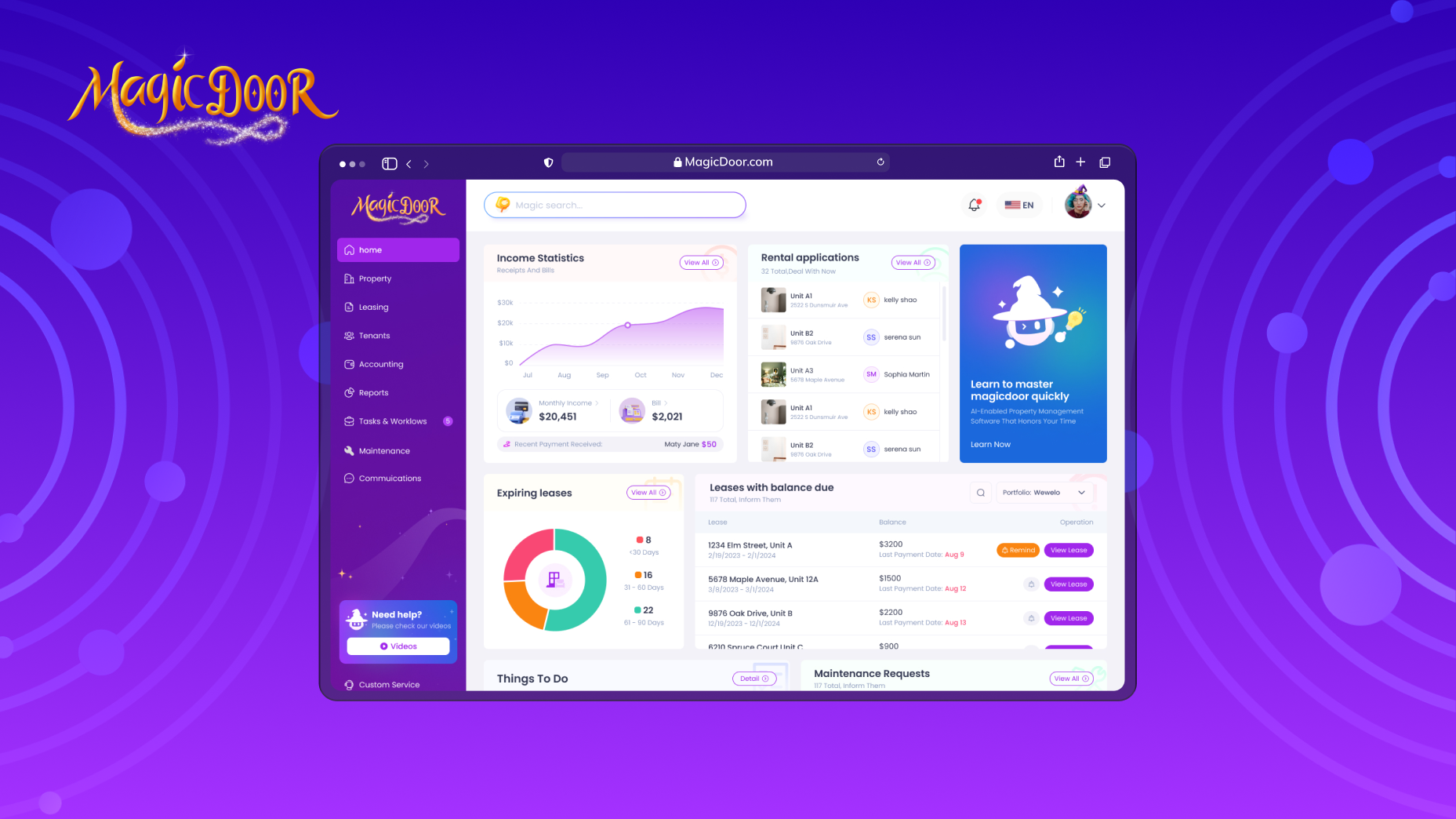
MagicDoor is an AI-powered property management platform built for landlords and property management companies handling residential, multifamily, commercial, and mixed-use portfolios.
The clearest differentiator is the depth of AI integration through Genie AI, which executes work instead of drafting it, paired with pricing that doesn't require a 50-unit minimum to get in the door. For property managers running portfolios of under 200 units who feel they've been filtered out or overcharged by AppFolio, MagicDoor stands out as the best AppFolio alternative in this roundup.
Pricing runs in three tiers:
- The Free plan covers landlords managing up to 9 leases at no cost.
- Advanced begins at $25 a month, and the number of leases is unlimited
- Pro begins at $225 per month, with unlimited leases.
Free unlimited texting comes built into Advanced and Pro, and Pro also includes $0 ACH on rent payments, along with white-glove data migration when teams switch from another platform.
You can send same-day ACH payments with MagicDoor without the per-transaction fees that compound on every rent cycle.
The structural difference from AppFolio is the entry point. MagicDoor has no unit minimum, so a landlord with 30 doors and a property management business with 700 leases can both run on the same platform, paying only for what they have.
For property managers seeking the right property management software without per-unit penalties at scale, this is the structural answer to most complaints about AppFolio pricing.
MagicDoor features:
- Genie AI handles tenant communication end to end, preparing and sending replies over SMS, email, and the tenant portal in real time
- Maintenance triage and vendor routing run on AI, with the platform classifying work orders and matching them to vendors without manual ticket sorting
- Built-in tenant screening tools at $30 per application on paid plans, with applicant scoring covering credit, income, and rental history
- Property accounting, rent collection, expense tracking, and owner reporting are consolidated in one platform with a full general ledger, owner distributions, and 1099 prep
- Property type coverage spans residential, multifamily, commercial, and mixed-use portfolios from the same login
- The Free plan includes full Genie AI automation for landlords running up to 9 leases, with no AI feature limits between free and paid tiers
There's an honest trade-off worth naming.
Customer reviews for AppFolio routinely flag pricing transparency and support quality as recurring complaints, which factor into the alternatives search for many teams.
For small property managers, residential portfolios, and mixed-use businesses with 10 to 1000 leases, MagicDoor is the cleaner fit at a much lower total cost. Agentic AI improves property management is the bigger structural reason teams switch, beyond the price tag.
Buildium: Built for Growing Residential & HOA Portfolios
Buildium is a residential property management platform owned by RealPage, with the deepest HOA and community association support in this roundup. For portfolios under 500 units, it reads as a feature-rich rival to AppFolio at a lower price tag.
Pricing begins at:
- Essential: $62/mo
- Growth: $192/mo
- Premium: $400/mo
Essential limits e-leasing and skips inspection workflows. Higher tiers add per-unit fees, and at 200 units the math lands within a few dollars per unit of AppFolio once Growth-tier add-ons fold in.
Buildium features:
- HOA and community association management with dues collection, board portals, and violation tracking
- Resident center for online rent collection, maintenance requests, and lease renewals, plus owner portal for distributions and statements
- Property accounting with general ledger, bank reconciliation, and expense tracking replaces standalone real estate accounting software
- Tenant screening via TransUnion with credit, criminal, and eviction history pulls
- Listing syndication and applicant tracking for major rental marketplaces, plus lead capture
- Tax prep and 1099 reporting for property owners
AI is thinner than Realm-X or Genie AI, with Buildium leaning on rule-based automation. Higher tiers also gate features AppFolio includes by default, so sticker savings fade once feature parity becomes the goal. Commercial-heavy or AI-first teams should check the vs Buildium breakdown to see where the limits start.
DoorLoop: All-in-One Platform Built for Mid-Sized Operators
DoorLoop is an all-in-one property management platform for teams with 50 to 500 units who want the depth of AppFolio without the learning curve. The differentiator is ease of use, scoring highest at 94% on G2's 2026 Spring Grid Report.
DoorLoop publishes tiered pricing:
- Starter at $69/mo with basic features
- Pro at $149/mo adding AI features
- Premium at $209/mo with VIP priority support
DoorLoop features:
- Resident portal for online rent payments, maintenance requests, and document sharing
- QuickBooks integration with built-in property accounting, no double entry on the general ledger
- Property marketing via listing syndication and applicant tracking from inquiry through approval
- E-signature included on every paid tier with no per-document charge
- CRM and communication tools for property management for tenant, owner, and prospecting outreach
- Mobile apps for property managers and tenants handle most day-to-day work
DoorLoop's 79% adoption rate falls below the ease-of-use score in the same G2 report, since teams learn it fast but struggle to roll it out fully. AI runs on workflow rules more than execution. Commercial-heavy teams running CAM reconciliation and complex lease admin will outgrow the product, and a vs DoorLoop breakdown shows where the limits begin.
Yardi Breeze: Mixed Residential & Commercial Coverage at SMB Pricing
Yardi Breeze is Yardi Systems' simplified entry-tier, built for property managers who need residential and commercial coverage on one platform, without the complexity of Voyager. The differentiator is real commercial lease management at SMB pricing, with most alternatives here treating commercial as an afterthought.
Yardi Breeze publishes per-unit pricing:
- Breeze: $1/unit/month ($100 monthly minimum)
- Breeze Premier: $2/unit/month ($400 monthly minimum)
Breeze Premier adds advanced accounting and custom reporting at higher per-unit rates. Portfolios under 100 units pay the $100 floor regardless of actual count, pricing out the smaller landlords who'd otherwise fit naturally.
Yardi Breeze features:
- Commercial lease management with CAM reconciliation and rent escalation schedules
- Residential and commercial workflows in one platform, with accounting for property management backed by Yardi infrastructure
- Online rent collection and maintenance request portal
- Owner and tenant portals with statement and document access
- Custom financial reporting and bank reconciliation
- Affordable housing compliance on Premier tier with built-in [affordable housing portfolio] coverage
Yardi Breeze's interface feels dated when compared to platforms like MagicDoor, DoorLoop, or Buildium. AI capability is also limited.
Yardi has rolled out AI at the Voyager enterprise level, but Breeze gets less of it. The $100/month minimum filters out under-50-unit portfolios, and a vs Yardi Breeze breakdown shows where mid-sized teams run into the limits.
Rent Manager: Configurable Workflows for Non-Standard Portfolios
Rent Manager is a property management platform built around configurable workflows and module-based pricing. The differentiator is deep customization through forms, workflows, reports, and integrations, including support for unusual portfolio types and multi-entity structures.
The natural fit is the property management business whose portfolio doesn't match standard templates.
Rent Manager uses module-based pricing rather than published tiers. Teams pay for the base platform plus the modules they need, with quotes scaling by portfolio size. Setup and implementation fees apply, and the steep learning curve is real compared to out-of-the-box platforms.
Rent Manager features:
- Configurable workflows, forms, and reports for non-standard property types
- Module-based plans where teams pay only for what they use
- Built-in property management accounting with general ledger and bank reconciliation
- Resident and owner portals with online payments
- Hundreds of pre-built integrations and documented API access for custom workflows
- Coverage for residential, commercial, manufactured housing, self-storage, RV parks, and specialty rentals
Rent Manager's flexibility is double-edged. The platform takes longer to onboard than competitors and needs meaningful internal time to configure. The interface feels more dated than newer platforms.
Teams running standard residential portfolios will find Rent Manager's advanced features excessive for everyday work, with a vs RentManager breakdown showing where the depth becomes overkill.
Innago: Free Pricing for Independent Landlords
Innago is a free property management platform for independent landlords and small portfolios. The platform monetizes through tenant-paid fees on application screening and online rent payments rather than landlord subscriptions.
The natural fit is the under-50-unit landlord that AppFolio's minimum filters out entirely.
Innago is free for landlords on the base platform. Tenants pay around $35–$40 per application for credit and background screening, plus ACH or card processing fees on rent payments. The $0 landlord price moves the cost onto tenants, and tenant-paid fees can drag down application volume in competitive markets.
Innago features:
- Free landlord access with no unit minimum or subscription fee
- Online rent collection through ACH and card payments
- Tenant portal software for small landlords with screening and document tools
- Built-in tenant screening with credit, background, and eviction reports
- Lease creation and electronic lease signing
- Maintenance request tracking with coverage for residential, commercial, self-storage, and specialty rentals
Innago's free pricing comes with feature limits. AI is minimal, accounting basics compared to Buildium or AppFolio, integrations, and support channels are limited. Tenant-paid fees can reduce application volume when the total cost of ownership matters.
Innago fits the under-50-unit landlord prioritizing cost over depth, while a vs Innago breakdown shows where small property managers hit the ceiling on advanced features.
How to Migrate from AppFolio to a New Property Management Platform
Most teams that switch from AppFolio say the same thing once they're through: they started the data cleanup too late and the tenant communication too early, or vice versa. A realistic migration timeline for mid-sized portfolios runs 60 to 90 days, and the variance depends almost entirely on the cleanliness of the source data before import.
Exporting tenant records, lease data, financial history, and owner distributions from AppFolio produces raw files that rarely drop cleanly into a new system.
Duplicated records, mismatched field formats, and historical transactions that need reconciliation are standard output from any AppFolio export. Platforms like MagicDoor Pro include white-glove migration support that handles this cleanup internally, removing one of the main reasons migration timelines run long.
How to collect rent payments from tenants gives additional context on what the rent collection transition specifically involves.
Two items on the go-live checklist get more attention than they deserve, and two get almost none:
- Any tenant on autopay needs a new portal login and a new ACH authorization before the next billing cycle runs. This is where migration errors become delinquency records that didn't exist before.
- Owner communication through the owner portal software should start before go-live, so owners know where their new login will land, what statements will look like, and who to contact if something is wrong.
Running both platforms in parallel through one full billing cycle catches most errors before they reach anyone.
Staff training on the new system matters more than most migration plans admit. User experience quality varies meaningfully between property management software platforms, and teams moving to more configurable platforms face a steep learning curve compared to purpose-built options.
Day-to-day operations need to run cleanly before resident services, maintenance coordination, and owner reporting go live with real tenants.
Property management software that automates rent collection, maintenance requests, and accounting cuts the manual processes that compound during any transition period. Build training time into the go-live date, not the week after.
Rent reconciliation tools are worth setting up before migrating historical transactions, since reconciliation errors in the first month compound fast.
Common Mistakes When Switching from AppFolio
Switching mid-month: Going live mid-cycle means active autopay is already running. Any tenant on automatic payments needs a new ACH authorization in the new platform before the next billing date, and a mid-month cutover leaves no room to catch those who were missed.
Rent collection should be the first workflow fully tested before anything goes live with tenants. A first-of-month start gives the full billing cycle to find and fix setup issues before real money moves.
Underestimating data migration timelines: Most teams plan two to three weeks. Migrations typically run eight to twelve. Data exported from AppFolio requires meaningful cleanup before it can be imported cleanly.
Duplicated contacts, mismatched field formats, and historical transactions that need manual reconciliation are standard. Starting the data cleanup before finalizing the platform decision puts the timeline in better shape. Maintenance tracking records require particular attention, as work order history rarely maps cleanly to a new system.
Evaluating demos instead of daily workflows: Key evaluation criteria for AppFolio alternatives include maintenance workflow maturity, accounting integration quality, lease administration depth, and advanced reporting, beyond which platform demos the cleanest.
Walk the vendor through your three highest-volume day-to-day operations. Many integration claims from property management solutions look different when tested against real workflows rather than a scripted demo.
The right property management software becomes clear when comparing platforms against actual needs.
Skipping the parallel run: Running both platforms through one full billing cycle catches missed tenant setups, maintenance coordination issues, and resident and owner communication problems before anyone notices.
Track performance metrics in the new system during this window. Delinquency rate and maintenance resolution time surface problems faster than any support ticket. The month of parallel running carries a known cost. A botched cutover carries a much bigger one.
Choosing based on price alone: Published per-unit pricing rarely reflects total monthly cost.
Many property management software platforms charge separately for ACH payment processing, tenant screening, and SMS outreach, with add-ons that never came up in the demo. A platform that appears cheaper than AppFolio can reach the same total cost once integration capabilities and add-ons are factored in.
Run the full accounting on the total cost of ownership at your portfolio size before signing, and understand how owner statement software works in the new platform, since statement distribution is one area most teams don't test until the first live month.
Conclusion
Picking the right AppFolio alternative starts with portfolio size and property type, not feature count.
Lease administration depth, accounting integration quality, and maintenance workflow maturity do most of the sorting. Landlords with under 50 units fit best with Innago or MagicDoor's free tier. Mid-market residential and HOA teams with fewer than 500 units will find Buildium the closer fit. Commercial and mixed-portfolio managers needing SMB commercial lease administration should look at Yardi Breeze.
MagicDoor covers the widest range, from 1 lease to 1,000, with full AI automation on every tier. If AppFolio doesn't fit your portfolio on price or design, one of these six will.

Frequently Asked Questions
Related articles





One platform for smart AI-automated rental management